A venue’s general business status and the availability of its pokies are separate claims that need separate checks.
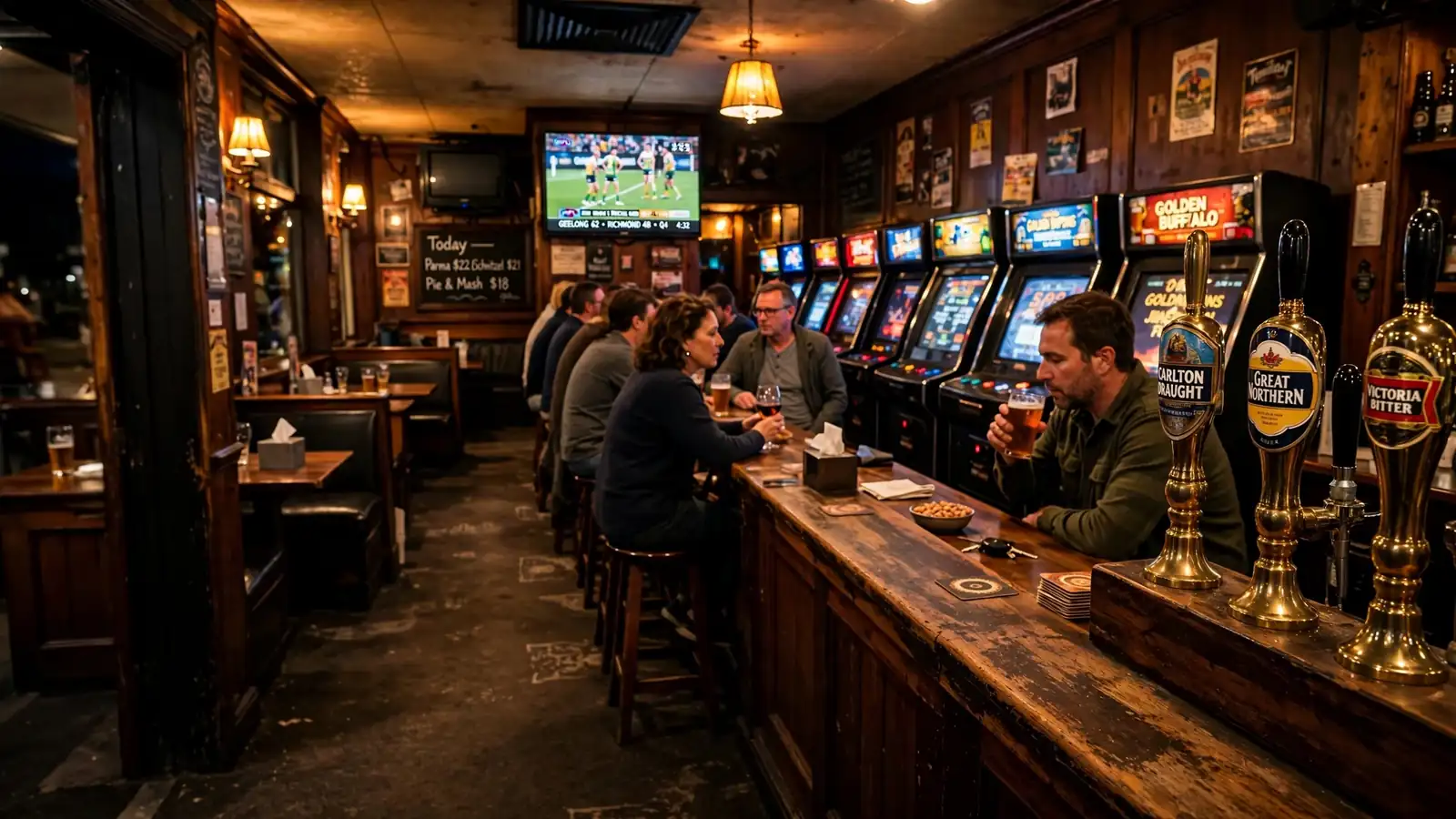
“Open now” looks like a simple question. In practice, it is a claim about a particular venue at a particular moment, and a general guide cannot confirm that from a distance. I would not treat a search result, an old listing or a page that merely mentions pokies as proof that a Geelong venue is open today.
That distinction matters if you are deciding whether to make the trip. A venue can have a web page without that page showing its current status. A listing can remain visible after details change. And a result that appears relevant to Geelong does not, by itself, establish that the place has pokies or that they are available when you arrive. Those are separate things to check.
I used to read a confident-looking result as if somebody had just checked it. That was optimistic. “Open” can mean the venue is generally in business, not that its doors are open at the time you’re looking. “Pokies available” can describe the venue in broad terms, not confirm the machines are operating right now. Small wording difference. Big difference if you’re already on your way.
Start by making sure the listing refers to the venue you intend to visit. Check that its name and location match across the venue’s own information and any listing you use. If the details do not line up, pause before treating the listing as a dependable answer. A map result can help you identify a place, but it is not the same as a live confirmation from the venue.
Then look for a current update from the venue itself. If its official page provides a phone number or another contact method, use that to ask the direct question: is the venue open now, and are the pokies operating? Asking both parts is useful. You want to know whether you can enter, and whether the activity you’re going for is actually available. A vague “yes, we’re open” may not answer the second part.
If you cannot get a clear answer, decide whether the trip is worth making without one. That sounds obvious, but I’ve talked myself into going on less evidence than that. The result was not some grand disaster; it was simply wasted time. Still annoying.
A page with opening information may be helpful for planning, but it can go stale. The same goes for a third-party directory or a map listing that has no recent update. Look for signs that the information belongs to the venue and is current, rather than assuming that a page appearing near the top has been checked recently.
Be wary of wording that blurs the question. A venue profile may describe facilities without saying whether they are available at the moment. A general statement about trading may not confirm a change affecting a particular day. And a result that says a place is “open” might refer to the broader venue rather than the pokies specifically. If the wording leaves room for doubt, contact the venue instead of filling in the gaps yourself.
I would also avoid treating a comment or review as live status. Someone’s account can be genuine and still describe a different day. It can tell you what that person experienced, not what you will find when you arrive. Useful background, perhaps. Not a current check.
The closer you check to leaving, the more useful the answer is for a question about current status. If you checked earlier and your plans changed, check again. If the venue’s own page is unclear, a direct call is the cleanest way to resolve it. Keep the question specific and listen for a specific answer.
This is not a promise that every venue will respond or maintain every listing. It is a practical way to avoid confusing a venue’s general presence with its live availability. If no current confirmation is available, the honest answer is that you do not know whether it is open now. That may be less satisfying than a neat list, but it is better than setting off on a guess.
For “pokies open now” in Geelong, I would want a current venue-level confirmation before relying on the result. For a visit later, I would check again nearer the time rather than assuming today’s status will still apply. No mystery to it. Just verify first.
If you’re looking for pokies options while in Geelong, checking the available operator information can help you decide what to investigate further. Use this list as a reference, and confirm the terms that matter to you before signing up.
LuckyVibe
LuckyVibe lists a Curacao Gaming Control Board licence, OGL/2023/176/0095, held by Hollycorn N.V.
Vegaz Casino
Vegaz Casino lists a Curacao OGL/2024/1335/0780 licence and a minimum deposit of EUR 20.
LevelUp Casino
LevelUp Casino lists a Curacao eGaming OGL/2023/174/0082 licence held by Dama N.V. Its minimum deposit is A$15.
SkyCrown
SkyCrown lists a Tobique Gaming Commission licence and a minimum deposit of A$30. Its stated payout times are around 10–15 minutes for crypto and 1–5 days for fiat.
SpinsUp
SpinsUp lists a Curacao Gaming Control Board OGL/2023/174/0082 licence held by Dama N.V.
JustCasino
JustCasino lists a Curacao Gaming Control Board licence.
Uptown Pokies
Uptown Pokies is listed as operating since 2017 under a Curacao licence. Its minimum deposit is A$20.
Roby Casino
Roby Casino lists a Curacao eGaming licence held by Roby Games Ltd.
Ricky Casino
Ricky Casino lists crypto payouts in under an hour and PayID payouts in 1–3 business days. Its minimum deposit is A$20, or A$30 to qualify for the bonus.
MrPacho
MrPacho lists crypto payout times of 30–120 minutes and fiat payout times of 24–72 hours. Its minimum deposit is A$30.
“Best paying” sounds like a useful label: pick the right pokie and the machine will eventually return more. I understand the appeal. I used to treat a run of losses as if it were building towards a win, then read a result from someone else as a clue about what might happen next. That reasoning feels tidy. It isn’t a forecast.
A pokie’s outcome is generated by a Random Number Generator (RNG). Each spin is a separate random event, not a continuation of the last one. A win does not make another win more likely, and a string of losing spins does not mean the next spin is “due”. The machine has no memory of what you watched happen a moment ago.
That is the bit I had to stop arguing with. “It has to pay soon” is a story players tell themselves, not information about the next result. The same goes for a machine that has just paid: the win is not evidence that it is about to pay again, nor that it has run out of good results. Previous outcomes don’t turn into a reliable signal.
The phrase can mean different things depending on who is using it. Sometimes it is a confident-sounding headline; sometimes it refers to a particular interpretation of a game’s figures. Either way, the phrase alone does not tell you what will happen on your next spin. It is not a promise of a return, and it cannot identify a machine that is about to produce a win.
Even when a claim sounds precise, keep the question narrow: does it describe a general property, or is it being presented as a prediction? Those are not the same thing. A figure attached to a pokie cannot tell you that your session will finish ahead, or how long you would need to play before seeing a particular result. I wouldn’t turn a broad label into a personal betting plan.
There is also a difference between a result someone reports and a result you can expect. A person might remember a big win vividly and tell the story as proof that a machine pays well. That story records what happened to them; it does not reveal what the RNG will produce for you. A string of losses is no better as evidence in the opposite direction. Both can feel persuasive because they are concrete. Neither predicts your next spin.
People are good at finding patterns, especially when money is involved. A sequence can look meaningful even when each outcome is random. You might see several losses, then a small win, and feel as if the machine is changing state. But the sequence does not provide a dependable reading of what comes next.
This is where “hot” and “cold” become slippery words. They describe how a run feels to the person watching, not a dependable forecast of the next outcome. The same goes for a near miss: it can look like the game almost gave you the prize, but it does not mean the next spin is closer to paying. A visual impression is not a signal from the RNG.
I’m not saying a result can’t be surprising or that a win can’t happen. Of course it can. I’m saying that once a spin is over, its result does not give you a useful lever over the following spin. Treating the past as a countdown is how I ended up making decisions for reasons that sounded convincing only while I was in front of the machine.
If you are comparing claims about the best-paying pokies around Geelong, read “best” as a claim that needs context, not as a tip about what to play next. No label can tell you that a particular pokie will pay during your visit. No previous result can remove the randomness from the next spin.
That matters whether you are thinking about a venue in the city, the CBD, or a pokie you have heard described as a casino favourite. The location and the story attached to a machine do not change the basic point: each outcome is generated independently. A machine’s recent run is not a queue, and a player’s anecdote is not a forecast.
My old mistake was looking for a pattern that would make chance feel manageable. It didn’t. If a claim makes you feel certain that a win is near, pause before treating that feeling as evidence. Random means random.
A search for online pokies around Geelong can make a website look like a local option. The location in its wording does not change who operates it or what Australian law allows. That distinction is easy to miss when a page talks about Geelong, real-money play, or a “no deposit” offer as if those details make the service an ordinary local choice.
The Interactive Gambling Act 2001 prohibits companies from providing real-money online pokies to people in Australia without a domestic licence. No such licences have been issued, and there is no Australian-licensed online casino. So a site’s claim that it serves Australian players is not evidence that it holds Australian approval. Nor does a Geelong reference turn an offshore operator into a local one.
That rule is directed at the operator, not at the individual player. Australians are not liable under the Act simply for playing on an offshore site that accepts them. But that does not make the operator Australian-regulated, provide the player with local protection, or remove the practical risks. Those points get blurred together in a lot of confident-sounding copy. They are not the same thing.
If an offshore casino refuses to pay winnings, an Australian player has no legal recourse in Australia to force payment. That is the part I would want clear before getting caught up in a headline about high limits or a bonus. “Fast withdrawals” is a sales phrase; it does not settle what happens when a withdrawal is disputed.
A site may accept Australian customers and still be beyond the reach of Australian remedies available for a locally regulated service. The operator’s terms, its own complaint process and any overseas arrangements are not a substitute for Australian legal recourse. If the operator withholds money, the player may have little practical leverage here. That risk remains even if the site looks polished or uses Australian references.
I’ve learned to treat offers as claims, not protections. A “no deposit” label tells you nothing about whether the operator is licensed in Australia or whether you could recover money after a dispute. Likewise, searching for the best-paying option near Geelong cannot establish that an online service is lawful or safe to rely on. The wording is not proof.
The Australian Communications and Media Authority (ACMA) enforces the Interactive Gambling Act 2001 and blocks access to illegal offshore gambling sites. Internet service providers must comply with ACMA’s blocklist. As a result, an offshore gambling site may be inaccessible from Australia, including if a user previously reached it or sees it mentioned elsewhere.
A page being visible, or a link still appearing online, does not mean the service is authorised here or that access will continue. I would not treat a workaround for a blocked site as reassurance. A block is part of enforcement, not a recommendation to find another route.
That matters whether you are looking for online pokies from Geelong, a no-deposit offer, or a particular bet size. Those search details do not change the legal position. Real-money online casino services are not licensed in Australia, while offshore operators that accept Australians remain outside the local protections a player might assume apply.
The practical line is plain: the law prohibits operators from supplying these services to people in Australia without a domestic licence, and no domestic licences have been issued. The player is not the target of that prohibition, but if an offshore site refuses a payout, Australian legal recourse is not available. Don’t confuse being able to reach a page with having protection when something goes wrong.
A map pin can make a venue look like an easy stop. It does not tell you whether the pin is current, whether the entrance is where you expect, or whether the place is practical to reach from your starting point. When I’m checking for pokies around Geelong, I treat the map as a lead, not a finished travel plan.
Start by confirming the venue’s own name and street address through a source it controls, such as its official website or a direct phone call. Then compare that address with the map listing. If the details don’t match, pause before setting off. A familiar venue name attached to an old listing is no help when you’re already on the road.
The same care applies to searches around Geelong’s CBD. “Near the centre” can mean different things depending on where you are starting and how you plan to travel. Check the exact destination, then look at the route itself: the pedestrian approach, parking arrangements, public transport connections or any transfer you would need. A map’s estimated travel time is a guide, not a promise; traffic and service conditions can change.
Airport searches need one extra step: make sure you have identified the airport you mean before comparing routes. A result described as near an airport may refer to a broad surrounding area rather than a convenient stop on your journey. Check the destination address against the airport location and your intended route. If you are arriving with luggage or relying on a connection, a small detour on a screen can turn into a much bigger hassle in practice.
I’ve learned not to let a search result do the thinking for me. A listing may show a pin and a phone number, but that does not establish that the details are current. Look for a recent update, check the venue’s own information, and call if anything is unclear. Ask for the correct entrance or the best way to reach the venue from the point you have in mind. That is more useful than trusting a vague “near me” label.
Keep the question simple: can you confirm the destination, and does the route make sense for your trip? Do that before leaving, rather than trying to sort out conflicting map results from a car park or terminal. If the information does not line up, choose not to travel until you can clarify it. Better a quick call than a wasted trip.
CBD, North Geelong and airport searches can point you in different directions; the place name in a result is not enough to establish where you will end up. Confirm the venue directly, then plan the route from your actual starting point. No guesswork.
When you’re weighing up a Geelong venue, “best” shouldn’t just mean the room looks polished or the machines catch your eye. I’d want to know what support is actually available if gambling stops feeling like a bit of entertainment. A venue’s safeguards matter more than its sales pitch.
A report by regionriverina.com.au describes a requirement for venues with more than 20 gaming machines to have a dedicated Responsible gambling officer (RGO) on duty whenever the machines are operating, with the change taking effect from 1 July. The report also describes a one-month grace period for venues to bring in the officers and remove signage covered by the change. That’s a specific staffing obligation, not proof that every venue has the same number of machines or the same setup.
An RGO is a person on duty in a role focused on responsible gambling. If you’re concerned about your own play or someone else’s, asking staff who the RGO is may be a more useful first step than relying on a general sign near the machines. I wouldn’t assume the person is immediately visible, though; ask directly.
The same report says venues will be required to keep a gambling incident register. It is intended to record occurrences, including situations where a patron’s behaviour suggests they may be at risk of gambling harm or already affected by it. That gives the venue a formal way to note concerns rather than treating every incident as an isolated conversation.
A register isn’t a guarantee that staff will spot every problem, or that recording an incident fixes it. It is one part of a venue’s responsibility. If you’re looking at a place to play, you can ask how staff handle concerns, who you should approach, and what happens if you ask for help. Clear answers are more meaningful than a vague “we care” sign.
There are practical safeguards you can use yourself, too: deposit limits, loss limits, session time limits and self-exclusion options. These don’t make gambling risk-free, and they work best when you decide on boundaries before you start, not after a rough run. I’ve learned that the hard way: once you’re chasing a loss, a limit you never set is no help at all. Keep it simple.
Pay attention to signage as well. Directions to gaming lounges should not be placed within sight of ATMs or EFTPOS terminals, and directions to ATMs should not be visible from gaming machines. That separation matters: a prompt to keep playing or to get more cash can make a bad moment worse.
These are venue standards and tools, not a scorecard for Geelong clubs. They won’t tell you which venue has the “best” pokies, and they shouldn’t be treated as a promise of a safe outcome. They do give you concrete things to ask about before deciding where to spend your time.
A “24-hour” label sounds useful when you are deciding whether to head out late, but it is not a substitute for checking the venue itself. Opening times can be listed inaccurately or change, and a broad claim does not tell you whether a particular Geelong venue is open when you plan to arrive.
I’ve learned not to treat a search result as a green light. Before travelling, look for the venue’s own current hours and contact it directly if anything is unclear. Ask whether the venue is open at the time you intend to visit, rather than relying on an old directory entry or a page that simply describes it as open all day and night. A phone call is less exciting than a confident-looking listing. It is also less likely to waste your trip.
Be precise about what you are checking. A venue’s general business hours may not answer every question about access to its pokies. If your visit depends on being able to play, confirm that directly with the venue rather than assuming that a late opening time means the gaming area is available throughout. Keep the answer current: information you checked previously may not reflect today’s arrangements.
“Open now” is especially easy to misread. A status shown online may not update immediately, and it may refer to the venue as a whole rather than the particular area you intend to visit. If you are already on your way, use direct contact to confirm before making the detour. If nobody answers, do not treat silence as confirmation.
There is no reliable shortcut here. A claim that a place is open around the clock needs to be tied to a named venue and checked against that venue’s own current information. Without that, it is just a claim. Same goes for a listing that gives a closing time but no date or clear indication of when it was last updated.
I would also check the practical details before leaving: whether the venue is operating today, what hours apply to your planned visit, and whether those hours cover the pokies area. Save the venue’s contact details, and recheck if your plans change or you are travelling later than expected. It takes a moment. Better than arriving to a locked door.
Treat “24-hour” as something to verify, not a promise about Geelong venues. The only answer that matters for your trip is the current one from the venue you intend to visit.
A search for Crown and Geelong in the same breath can make the connection sound settled. It isn’t. A name appearing beside a place in a search result, map label or discussion does not, by itself, show that Crown operates a casino in Geelong or that Crown machines are available there.
I’ve learned to separate the thing I’m trying to find from the wording that led me to it. “Crown” might be part of a comparison, a question, an old post or a result that has joined separate topics. None of those tells you what is actually at a Geelong venue. Convenient-looking snippets are not proof. That matters when you’re planning a trip, not just browsing.
The same goes for asking for the best pokies room in Geelong. “Best” needs a real basis: what is being compared, who checked it and when? Without those details, a confident label is just a label. I wouldn’t treat it as evidence of a Crown connection, a local machine selection or an independent ranking.
The phrase “maximum cash payout” can also sound more definite than it is. A number shown in a general discussion may refer to a particular game, venue, condition or point in time; it cannot be carried over to a different place just because the searches mention both. I wouldn’t plan around a headline figure without confirming the applicable terms with the venue. No magic number.
If you’re checking a specific claim, look for the venue’s own current information and make sure it identifies the actual location and operator—not merely Crown in a heading or search snippet. If the details still don’t line up, contact the venue before making the journey. That is a more useful check than assuming a familiar name means familiar machines.
I’ve been burned by treating a polished label as a promise. It’s easy to read “Crown Geelong” as a destination when it may only be a string of words placed together. Keep the distinction clear: a Crown-related search does not establish a Crown casino in Geelong, nor does it establish that Crown pokies are available locally. No guessing from the name.
A request for the best pokies in Geelong’s CBD sounds like it should lead to a shortlist of clubs.
That matters because “best” can mean different things: a venue you can reach easily, a room that feels comfortable, or simply somewhere you already know. A polished list is still guesswork.
If you have a club in mind, check its own current information and contact it directly to confirm whether pokies are available there. Treat third-party listings as a starting point, not proof. Details can be out of date, and a venue name appearing in a directory does not establish what facilities it has.
I’ve learned not to confuse a confident recommendation with a checked one. That’s an easy trap.
Self-exclusion is one of the responsible-gambling tools available in Australia, alongside deposit, loss and session-time limits. If you want to exclude yourself from a particular venue, ask that venue directly what its process involves and what areas or activities the arrangement covers. Don’t assume that a general online tool automatically applies to a local club, or that one exclusion arrangement covers every place you might visit.
BetStop is relevant to Australian-licensed operators; it does not bind offshore sites. That distinction matters if you’re looking for a way to keep a gambling boundary in place across different settings.
I’d keep the practical question simple: confirm the venue and its pokies directly, and ask about its exclusion process before relying on it. No invented shortlist, no “best” badge without evidence.
A reference to Parkes alongside Geelong is hard to interpret on its own. It could be a place name, part of a venue name, or wording someone has used for another reason. Without a reliable link between the term and a specific Geelong venue, I can’t tell you which meaning was intended. Guessing would turn a vague phrase into a claim about a real place.
That matters if you are looking for pokies in Geelong and expect a Parkes reference to point you somewhere definite. It does not establish that a venue called Parkes exists in the area, that a venue is associated with that name, or that the phrase describes a particular part of the city. Those are different possibilities, and none should be treated as confirmed just because the words appear together.
I’ve learned not to fill gaps like this with confident-sounding detail. A name can look like a useful clue, but attaching it to a venue without a clear basis may send you in the wrong direction. It can also make an unverified result look like a local recommendation. That’s not useful.
The same caution applies to lists labelled as the best pokies in Geelong. A Parkes reference does not identify a venue, let alone support a ranking. Unless the name can be matched to a trustworthy venue listing or confirmed directly with the venue, it is safer to leave it unresolved than to treat it as a fact.
So, if you encounter Parkes in connection with Geelong pokies, take it as an unclear reference rather than a destination. I can’t responsibly tell you what the wording refers to or tie it to a Geelong venue. No guesswork.
“Cashless” can mean different things. A venue might take a bank transfer for something unrelated to play, while a pokie might still use a different payment method. I can’t confirm whether Geelong venues offer cashless pokies, so I wouldn’t treat a payment logo or a claim about cashless play as proof that machines are available on those terms.
PayID is a bank-transfer alias, not a type of pokie or a licence. It sits on the New Payments Platform (NPP) and lets someone direct a transfer using an email address, mobile number or ABN instead of entering account details. The NPP is supported by all major Australian banks and uses end-to-end encryption.
That describes how a transfer is addressed and transmitted. It does not tell you what a venue’s machines accept, whether a particular payment is allowed for gambling, or whether an online service is lawful. A site displaying PayID has not thereby demonstrated that it is licensed. There is no Australian-licensed online casino, and PayID cannot change that.
I used to read a familiar payment option as a kind of reassurance. Wrong signal. Payment plumbing is not a stamp of approval.
If you’re trying to work out whether a venue in Geelong—or Newcastle—has cashless pokies, keep the question local and specific: ask the venue what payment methods apply to its machines, rather than relying on general claims about PayID. Don’t assume that a bank transfer option for one purpose applies to another. The same distinction matters online: the existence of a transfer method says nothing by itself about the legal status of the service.
So, treat “cashless” as a claim to check, not a feature you can infer from PayID. One thing does not establish the other.
Yes, Australian players can legally play on offshore sites that accept them, but no Australian-licensed online casino exists. Operators cannot legally offer real-money online pokies to Australians without a domestic licence, and no such licences have been issued. If an offshore casino refuses to pay you, you have no legal recourse in Australia.
You must be at least 18 years old to gamble online in Australia.
There is no strategy that can predict a win: each spin is an independent random event, so previous wins or losses do not affect the next outcome. Set deposit, loss or session-time limits, or use self-exclusion tools to help manage your play.
It is the amount you must bet before you can withdraw bonus winnings. For example, a $500 bonus with a 40x requirement means you must place $20,000 in bets; if the requirement applies to a $500 deposit plus a $500 bonus at 35x, you must bet $35,000.
Created by the ”Richard Casino” editorial team.