A practical guide to offshore casino deposits, crypto networks, bonuses, verification claims and the limits of legitimacy labels.

The basic flow is simple on paper: an offshore casino lists the cryptocurrencies it accepts, you choose one, send funds to a deposit address, and the account balance updates after the transaction is processed. That’s the mechanical part. It can feel more fiddly than paying by card because you’re moving money between wallets, and a small mistake can matter.
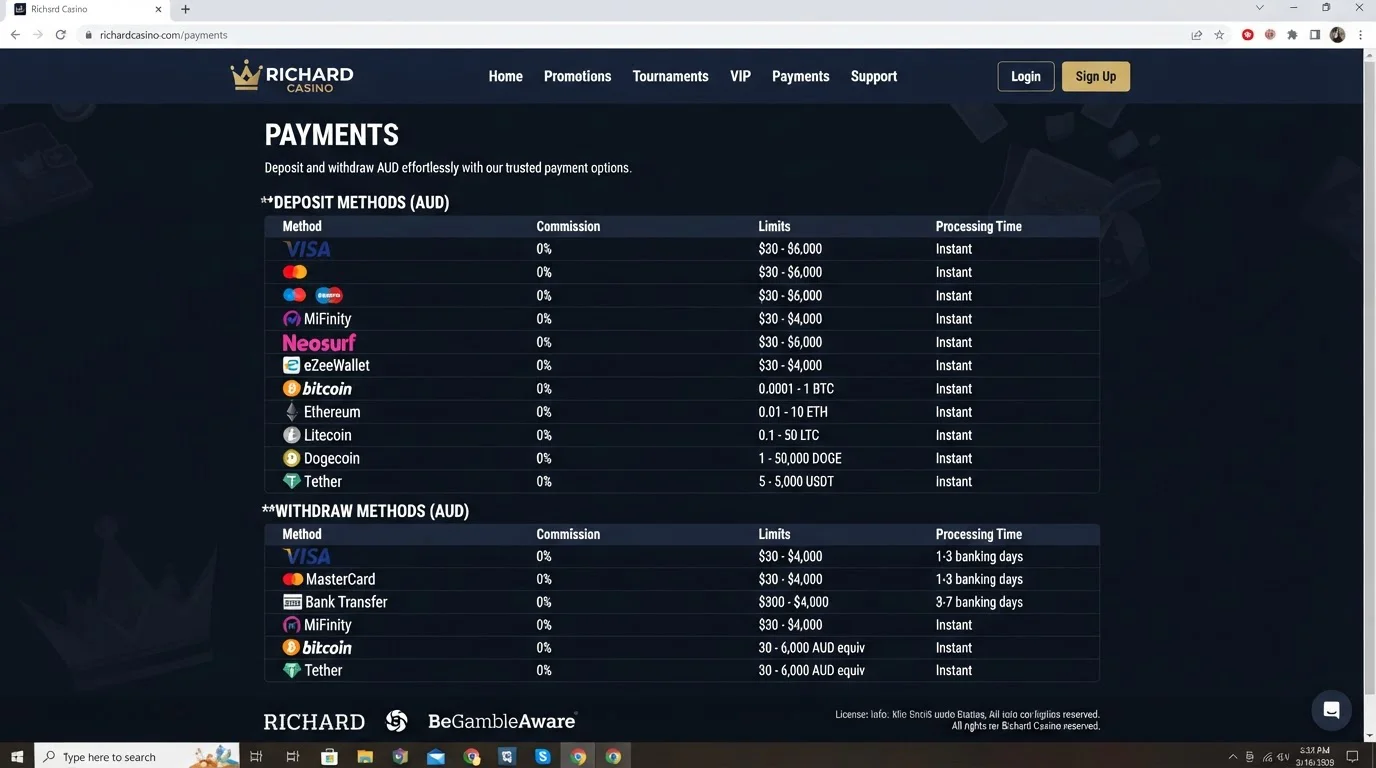
These sites typically accept Bitcoin, Ethereum, stablecoins and other cryptocurrencies, but the options vary by operator. Start by checking the cashier’s deposit page rather than assuming the coin you hold will work. The same currency can also be available on more than one blockchain network. The currency name alone is not enough: the network shown in the casino’s instructions must match the network you select in your wallet. Get that wrong and the transfer may not arrive where you expect. Crypto transfers can be irreversible.
Once you know what the cashier accepts, the next step is to open your own wallet or exchange account and check that you can send the selected asset. You’ll need enough to cover the amount you intend to transfer and any network fee charged along the way. The figure displayed in your wallet may be in crypto, Australian dollars, or both. Check which unit you’re reading before you confirm. I’d rather take an extra moment here than trust a number I’ve only glanced at.
At the casino, the cashier will display a deposit address, and may provide a QR code as well. Treat that address as destination details, not as a general-purpose wallet address to reuse blindly. Copy it carefully or scan the code, then compare the address in your wallet with the one shown by the cashier. Confirm the coin and network, too. If anything differs, stop and check the instructions again. Don’t send a test amount unless the site’s stated process supports it; even a small transfer can be lost if sent incorrectly.
The casino may also display a minimum deposit or an amount to enter. Those terms are set by the operator, not by crypto itself. Before sending, check how the cashier describes the amount, whether it expects a particular network, and what happens if the transfer arrives below the stated minimum. Don’t assume that a deposit is credited the moment you press send. The transaction has to be broadcast to the network and then recognised by the casino’s payment system. The timing can vary, so a pending status is not automatically proof that funds have vanished—or that they have arrived.
When a deposit is credited, the account balance may appear in crypto or be shown as a converted balance. Either way, the number on screen can change in Australian-dollar value as the market moves. That cuts both ways: the amount you send can be worth something different by the time it is credited, and a withdrawal can have a different value by the time it reaches your wallet. Crypto is not a steady-value wrapper around a casino balance. Keep that in mind before treating the display as a fixed amount of money.
A withdrawal follows the reverse route, but it is not simply a deposit played backwards. You enter a wallet address and choose the asset and network the cashier supports. Check all three before confirming, especially the destination address. The casino may show the request as pending before it is sent to the blockchain; then the network has to process it. A status label inside the account and a completed wallet receipt are different things. Keep the transaction details until the funds appear in the receiving wallet.
There’s another part people sometimes skip: offshore crypto casinos are not regulated by Australian authorities, so you do not get Australian consumer protection through that operator. A domain can also disappear without notice if ACMA directs internet providers to block it. That can make access unreliable, even when you have saved the address. This is not a local, protected payment service. Don’t treat a familiar-looking cashier as proof otherwise.
You must be at least 18 to gamble. And using crypto does not make an offshore casino safe or make a transaction error easy to reverse. I’d treat every transfer as money already out of my hands: check the asset, network, amount and destination before sending, then keep a record. Slow down. That’s the whole trick.
Making a Deposit
Check the Cashier
Verify which cryptocurrencies and blockchain networks the casino accepts on the deposit page.
Prepare Your Wallet
Open your wallet and ensure you have enough of the selected asset to cover the transfer and network fees.
Verify Destination
Copy the deposit address or scan the QR code, then compare it carefully with the address in your wallet.
Confirm and Send
Match the coin and network one last time before confirming the transfer to the blockchain.
The first distinction is between the operator and the person using a site. Under the Interactive Gambling Act 2001, providing real-money online casino games to people in Australia is prohibited. That covers casino-style services such as slots, poker and table games. An Australian-licensed operator cannot offer those games to residents here.
Offshore crypto casinos sit outside Australia’s regulatory framework; they are not licensed by Australian authorities. That does not make them Australian-regulated alternatives, and it does not give you local consumer protection if a dispute arises. A site’s foreign licence, where it has one, is not Australian approval.
The position for an individual is different. It is not a criminal offence for an Australian resident to gamble at an offshore online casino. The law is directed at operators, not players, and a person does not incur a fine simply for placing a bet there. Players must still be at least 18 to gamble.
That distinction can sound reassuring until you look at what it does—and does not—mean. It does not turn an offshore casino into a lawful Australian service or provide the protections you would expect from a locally regulated gambling product. If an account is closed or a payment is disputed, the fact that you personally have not committed a crime does not create an Australian regulator that can make the operator resolve it.
The Australian Communications and Media Authority (ACMA) regulates online gambling under the Interactive Gambling Act. It monitors online gambling, including activity involving cryptocurrency, and directs internet service providers to block prohibited offshore gambling sites. A domain can therefore disappear from access without warning. That is a practical consequence of enforcement, not evidence that a platform has become safe or approved.
Advertising is another part of the picture. Real-money online casino services cannot be advertised to Australian audiences. So a prominent promotion aimed at Australians should not be mistaken for a sign that the service has local permission to operate.
Using Bitcoin or another digital currency does not make an online casino fall outside gambling rules. The relevant issue is the service being provided, not whether the deposit is made with cash, a card or crypto.
There has also been a change to domestic wagering payments. Since 11 June 2024, licensed wagering services in Australia have been barred from accepting credit card or digital-currency transactions for wagering. That rule concerns licensed domestic wagering services; it should not be confused with permission for an offshore casino to provide online casino games to Australians.
A specialist legal commentary has described the 2023 amendments as seeking to restrict operators from accepting digital-currency payments from Australians. The careful wording matters: the stated aim of amendments is not a blanket assurance about how every offshore site operates today. Nor should a crypto payment option be read as evidence that a casino has authority to serve Australian residents.
When you see “Australian crypto casino” attached to a site, treat it as a description of the audience the site is pursuing, not proof of an Australian licence. The operator may be offshore, outside Australian oversight and beyond the protections that come with local regulation. ACMA blocking can also interrupt access to a domain.
I have learned not to let a familiar payment method blur those boundaries. Crypto changes how value moves; it does not rewrite the law. And a player’s lack of criminal liability is not the same as a guarantee that an offshore operator will honour a balance or settle a disagreement. Be clear about that difference before weighing any other claim.
“Crypto slots” sounds like a distinct kind of game. Most of the time, it simply means slot-style games offered by a casino that also accepts cryptocurrency. The payment method does not tell you what is in the games, how they work, or whether a particular title is available to you. I used to treat the crypto label as if it answered more than it did. It doesn’t.
If you’re looking at an online casino’s games, start with the information attached to each title rather than the headline around it. Check whether the game has a rules or information panel, and read what it says about the paytable, symbols, bonus features and any stated return-to-player figure. A percentage, where shown, is a theoretical measure across extended play, not a forecast of what your own session will return. It can’t tell you whether you’ll win.
Look for the mechanics, too. A game may offer a different number of paylines, ways to win or bonus rounds from another game with a similar appearance. Those details affect how a spin works; they do not make one game a safe choice or a reliable way to get money back. If the rules are hard to find or unclear, that is a reason to pause rather than fill in the blanks yourself.
The word “crypto” can also blur two separate things: the way a casino takes payment and the games it provides. A site may support digital currency without every game having anything specifically to do with crypto. A slot’s theme, features and rules are separate from the currency you might use on the site. Keep those ideas apart and the marketing starts to look less impressive.
I’d also check whether the casino identifies the game’s provider and whether the title shown in the lobby matches the information page. That is a basic consistency check, not proof that every claim about a game is correct. A polished tile and a familiar-looking name are easy to present; the useful detail is in the game information itself. If the page gives you little to inspect, don’t assume the missing detail would have favoured you.
Some players look for “provably fair” games when they hear about crypto casinos. That label should not be treated as a synonym for every slot offered by a crypto casino. It describes a claim about how outcomes can be checked, and you would still need to understand what the particular game says it does. A crypto payment option alone does not establish that a slot is provably fair.
It is worth being wary of broad claims about a huge choice of crypto slot games. A count or a wall of thumbnails can look convincing while telling you little about what you can actually examine. Titles may be grouped under generic labels, and the lobby can change. Check the specific game details that are visible to you, rather than assuming a site-wide description tells the whole story.
You can make a short checklist before spending time in a lobby: find the game rules, note any stated return information, understand the features, and see whether the provider is identified. If you cannot answer those questions from the game’s own information, you have less to go on. I’ve learned not to mistake a neat presentation for useful evidence. Looks tidy. Means little.
And keep the basics in view: gambling is for adults aged 18 or older. A slot title, a crypto label or a detailed game page does not change that. The sensible question is not whether a game sounds made for crypto; it is whether you can understand what is being offered before deciding what to do.
If you’re looking at Aussie crypto casinos in 2026, licensing and the few available payment details can help you decide what to check next. Use these brief notes as a starting point, not as a substitute for reviewing the terms.
LuckyVibe
LuckyVibe lists a Curacao Gaming Control Board licence, OGL/2023/176/0095, held by Hollycorn N.V.
Vegaz Casino
Vegaz Casino lists Curacao licence OGL/2024/1335/0780. Its minimum deposit is EUR 20.
LevelUp Casino
LevelUp Casino lists a Curacao eGaming licence, OGL/2023/174/0082, held by Dama N.V. Its minimum deposit is A$15.
SkyCrown
SkyCrown lists a Tobique Gaming Commission licence and a minimum deposit of A$30. Its stated payout times are around 10–15 minutes for crypto and 1–5 days for fiat.
SpinsUp
SpinsUp lists a Curacao Gaming Control Board licence, OGL/2023/174/0082, held by Dama N.V.
JustCasino
JustCasino lists a Curacao Gaming Control Board licence.
Uptown Pokies
Uptown Pokies is listed as operating since 2017 under a Curacao licence. Its minimum deposit is A$20.
Roby Casino
Roby Casino lists a Curacao eGaming licence held by Roby Games Ltd.
Ricky Casino
Ricky Casino lists crypto payouts under one hour and PayID payouts in 1–3 business days. The minimum deposit is A$20, or A$30 to qualify for the bonus.
MrPacho
MrPacho lists a minimum deposit of A$30. Its stated payout times are 30–120 minutes for crypto and 24–72 hours for fiat.
“Best” sounds like a verdict. On an offshore crypto casino page, it is usually a label attached to a set of claims: smooth payments, a big game library, helpful support, generous promotions. Those things may matter to you, but none changes the basic fact that the operator is outside Australia’s regulatory framework.
I’ve made the mistake of treating a confident ranking as if someone had done the hard checking for me. A tidy table and a punchy “top choice” badge look reassuring. They aren’t proof that a site is safe for Australians, or that you’ll have a useful way to resolve a dispute. The ranking tells you what its writer prefers to highlight. It does not give an offshore operator Australian oversight.
That difference matters more than whether a page looks polished. Offshore crypto casinos are not licensed in Australia. They operate beyond the local regulatory framework, so Australian authorities do not provide the consumer protections you might expect from a locally regulated service. A site can still describe itself as trustworthy, established or player-focused. Those are the operator’s words, not an Australian approval.
So what can “best” mean in practical terms? At most, it can mean “best according to these particular criteria.” Before taking a ranking seriously, look at what those criteria actually measure. Does the page explain how it reached its verdict, or does it mainly stack up superlatives? Does it distinguish between information it has checked and promotional claims? Can you tell what the ranking cannot establish? If those questions go unanswered, the score is decoration. Useful decoration, maybe. Still decoration.
I also try to separate a site’s presentation from the protection behind it. A neat design, a long list of features or a quick reply from support may tell you something about the experience. They cannot turn an offshore business into an Australian-licensed one. They cannot guarantee that a complaint will be handled in your favour. That’s the part I used to skim past because the page made everything feel settled.
A “best crypto casino Australia” label can be especially slippery. It may mean the writer considers a platform accessible to Australians, not that it has Australian approval or consumer safeguards. Those are very different claims. Don’t let a country name in a headline do the work of a regulator.
The same goes for a list of sites. Being included is not a quality certificate, and being placed first is not a promise about what happens if something goes wrong. I’d read the explanation behind the list before I gave any weight to its order. If the page offers only a winner and a handful of glowing adjectives, I treat it as advertising with a ranking attached.
There is no magic checklist that makes an offshore platform risk-free. My own rule is less exciting: ask what the ranking proves, then ask what it can’t possibly provide. If the answer to the second question is Australian oversight, that missing protection should carry more weight than a badge or a high score. And if you can’t tell how the verdict was reached, don’t mistake confidence for evidence.
No neat shortcut.
“No deposit” sounds like money with no strings attached. I used to read the headline and treat the rest as fine print. That was backwards. A promotional label tells you how an offer is presented; it does not tell you what you can withdraw, what play is required, or whether the offer is available to you.
If a crypto casino advertises a no-deposit bonus, start with the terms attached to that exact promotion. Look for who can claim it, which games count, whether winnings are restricted, and what conditions apply before a withdrawal. Check whether the terms refer to a bonus balance, cashable funds, or both. If the wording leaves any of that unclear, the headline has not answered the important part.
I learned the hard way that “free” can describe the entry point, not the outcome. A bonus may be conditional, and accepting it can affect how you play or whether you can access a balance. Don’t deposit crypto simply because a promotion makes a small first step look risk-free. A deposit is still your money, and crypto’s value can change between sending it and using or withdrawing it.
The same applies when an offer is described as the best crypto casino no-deposit bonus. “Best” is a sales claim, not a term you can cash out. Compare the actual written conditions rather than relying on a banner, a short review, or a countdown-style prompt. Save or screenshot the terms shown when you consider an offer; promotional wording can change, and you want to know what you agreed to.
Be especially careful if the promotion asks you to act before you can read its rules. I would not accept an offer just to find out what it means afterwards. Check whether the casino can change or withdraw the promotion, and whether opting in is required. Those details matter more than the size of a headline figure. No magic shortcut.
There is a bigger context, too. Offshore crypto casinos are not licensed in Australia, sit outside the Australian regulatory framework, and do not provide Australian consumer protection. A bonus does not change that position. The Australian Communications and Media Authority blocks prohibited offshore gambling sites, so a domain can become unavailable without notice. Do not treat a promotion as proof that a service is approved for Australians.
You must be at least 18 to gamble. If you choose to assess a promotion, read the conditions before taking any action, and do not assume crypto removes other checks or risks. A “no-deposit” label may sound simple. The terms decide what it actually means.
“No KYC” sounds like a promise of privacy. I’d read it as a claim about a process, not proof that a casino cannot ask who you are. The phrase may mean there is no identity check at sign-up, or only that checks are not required for every account straight away. It does not establish what happens when you deposit, withdraw, or trigger a review.
Using cryptocurrency does not make you anonymous by default, and it does not remove the possibility of identity checks. A site can still ask for documents or other information. If that happens after you have funds in an account, you may find yourself deciding whether to share personal details or abandon the balance. Not a great surprise.
Before relying on a no-KYC claim, look for the operator’s own terms on verification, withdrawals, and account reviews. Check whether those terms explain when documents can be requested and what happens if you do not provide them. If the wording is vague, treat the claim as vague too. A badge or headline is not a substitute for conditions you can actually read.
There is a separate issue for Australians: offshore crypto casinos are not licensed here and sit outside Australia’s regulatory framework. That means Australian authorities do not provide consumer protection for your account or a dispute with the operator. “No KYC” does not change that position, and it should not be read as an endorsement or a guarantee of safe access.
Privacy claims also do not make a disappearing website less frustrating. The Australian Communications and Media Authority directs internet providers to block prohibited offshore gambling sites; a domain may become unavailable without notice. Keep that practical risk in mind before leaving funds or personal information with a service.
I’d avoid sending identity documents through a channel you cannot verify, and I would not assume that a site’s privacy wording tells the whole story. Read its privacy and verification terms carefully, and pause if you cannot understand how your information may be handled. If you choose to gamble, you must be at least 18. Crypto is not a cloak.
A review can look thorough and still tell you very little. I’ve learned to read past the verdict and ask what it is actually based on. Does it explain how the reviewer reached that conclusion, or just repeat the operator’s claims in a friendlier voice? Are drawbacks discussed with the same care as the selling points? If the page gives no clear basis for its praise, treat it as promotion, not proof.
That matters especially when a review talks up free spins. A bright banner or confident line about a “free” offer does not establish that an offer is available to you, what it applies to, or what conditions come with it. Those details can change, and promotional copy may leave the less attractive parts out of view. I wouldn’t treat a review’s summary as a substitute for the terms displayed by the operator—and I wouldn’t assume those terms settle the risks of using the site.
The same goes for claims about free spins on crypto slots. A review might describe a promotion, but that alone does not verify the current offer or the games it covers. Look for dated, specific evidence and a clear distinction between what the reviewer checked and what the operator advertises. If that distinction is missing, the claim is hard to weigh. Simple as that.
There is another limit that a glowing review can’t remove: offshore crypto casinos are not regulated by Australian authorities, so Australian consumer protection does not apply to them. ACMA can direct internet providers to block prohibited offshore gambling sites, and a domain may disappear without notice. A review page may remain online after the details it describes have changed.
I’d also be wary of review language that turns an uncertain promotion into a promise. “Best” and “exclusive” are labels, not evidence. A screenshot, if supplied, may show that a page once displayed something; it does not prove the offer is still active or that every important condition is visible. Read the actual terms, check when the review was updated, and be prepared to walk away if the details don’t line up.
And keep the basic boundary in view: gambling is for adults aged 18 or older. I know the pull of a free offer can make the fine print feel like an afterthought. It isn’t.
“Legit” sounds like a verdict. On an offshore casino’s page, it is only a claim made by the business; it does not show that Australian authorities have approved the site. The same goes for “top”, “trusted” or a polished badge. I’ve learned to separate confident wording from evidence.
The Australian Communications and Media Authority (ACMA) oversees online gambling under the Interactive Gambling Act. Offshore crypto casinos are not authorised under Australia’s regulatory system, so a foreign licence or an operator’s own assurance does not amount to Australian approval. Nor does a favourable review change that position. These platforms sit beyond Australian regulatory protections, leaving you without the local consumer safeguards that come with a regulated service.
ACMA can instruct internet providers to block prohibited offshore gambling websites. A specialist review reported that blocking notices had covered hundreds of domains by mid-2025; that is a dated snapshot, not a permanent count. ACMA also monitors online gambling, including activity involving cryptocurrency. A site disappearing from your connection may reflect a block, and an address that worked before can stop working without warning.
That matters when you see a neat list presented as the definitive set of legitimate options. A list can show what its publisher chose to include; it cannot certify Australian status. “All” is especially hard to take at face value when domains may be blocked or change. I would look for who is making the claim, what evidence they provide, and whether they clearly distinguish an overseas licence from Australian authorisation. If the distinction is blurred, that tells you something.
None of this means the word “legit” proves a site is a scam, either. It means the word alone settles very little. A real business can still operate outside Australian oversight, and an attractive presentation does not create local recourse if something goes wrong. Read the claim narrowly. Don’t let a ranking label do the work of a regulator.
There is also a basic boundary: gambling is for adults aged eighteen or older. Whatever a site says about its reputation, do not treat that as a substitute for checking your own circumstances or understanding the risks of dealing with an offshore operator.
Marketing talks loudly. Evidence matters more.
Bitcoin and Ethereum are the familiar starting points: both are supported by almost all crypto casinos. Litecoin and Tether (USDT) are also commonly accepted, while some casinos take Ripple and other altcoins. A specialist review identifies Solana and Dogecoin among the less consistently available options. That is a snapshot, not a promise about any particular cashier; check the deposit and withdrawal pages before moving funds.
The coin name alone is not enough. Tether, for instance, can be sent over different blockchain networks. The casino’s selected network and the one in your wallet must match. I’d learned to stop treating a familiar ticker as a complete address. Sending on the wrong network can mean funds do not arrive, and crypto transfers may be irreversible. Check the coin, network and receiving address together before confirming.
Network choice can change the cost and waiting time. One specialist review says TRC-20 transfers can cost cents, and points to Litecoin and TRC-20 Tether for quick confirmations and low fees. It also describes Bitcoin as better suited to larger, less frequent withdrawals when a wait of around half an hour is acceptable. Those are source-specific observations, not a guarantee: network congestion and a casino’s own processing can affect what you experience. Cheap is not the same as instant.
There is another cost people can miss: price movement. The value of a coin can shift between depositing and withdrawing, so the amount you put in may not have the same value when it comes back out. A stablecoin is designed to track a reference value, but that does not remove network fees or transfer risk.
I would not call any payment method a shortcut to a “secure” casino. Offshore crypto casinos are not regulated by Australian authorities and do not provide Australian consumer protection. ACMA blocking can also make a domain disappear without notice. You must be at least 18 to gamble. Before sending anything, verify the current network and address, and think through both transfer risk and value fluctuation. One wrong click can cost you.
An Aussie crypto casino can sound like a local service with a different payment option. That wording is misleading: offshore crypto casinos are not licensed in Australia, and using cryptocurrency does not bring them under Australian regulation or give you Australian consumer protection. They are not Australian-licensed alternatives.
The distinction that matters is who the law targets. Australian rules prohibit operators from providing online casino games to people in the country; accessing an offshore platform is not a criminal offence for an individual player. There is no known case of an Australian being prosecuted simply for placing a bet at one. That is not an endorsement or a promise that an offshore site is safe. Different thing.
I’ve learned not to treat “available” as “approved”. ACMA monitors online gambling, including activity involving cryptocurrency, and directs internet providers to block prohibited offshore sites. A domain can disappear without notice, so a site loading today is no guarantee it will remain reachable. Nor does a crypto payment change the operator’s status.
There are practical risks too. Crypto can change value between a deposit and a withdrawal, so the amount you send and what it is worth later may not match. And you must be at least 18 to gamble.
So, if you are weighing up an offshore platform, keep the label straight: it is an offshore service, not a locally regulated casino. The law’s focus on operators does not erase the financial and consumer-protection risks for players. I’d rather see that plainly than have “Aussie” do the reassuring for it.
Litecoin or Tether on the TRC-20 network can be practical choices for faster transfers with low fees. Bitcoin is better suited to larger, less frequent withdrawals; check that the casino supports your chosen coin and network.
You do not have Australian consumer protection through an offshore casino, and an Australian regulator cannot make the operator resolve your payment dispute. A foreign licence does not provide Australian approval.
Casinos commonly support Bitcoin, Ethereum, Tether, Litecoin and other cryptocurrencies. Transfer speed and fees depend on the asset and network: Litecoin and TRC-20 Tether can offer quick confirmations and low fees, while Bitcoin can involve a longer wait.
Yes, Bitcoin is supported by almost all crypto casinos, but check that the cashier offers it for withdrawals and confirm the required network and destination address before sending.
Created by the ”Richard Casino” editorial team.