General digital-payment use does not confirm a casino’s MiFinity cashier options, withdrawal support or bonus terms.
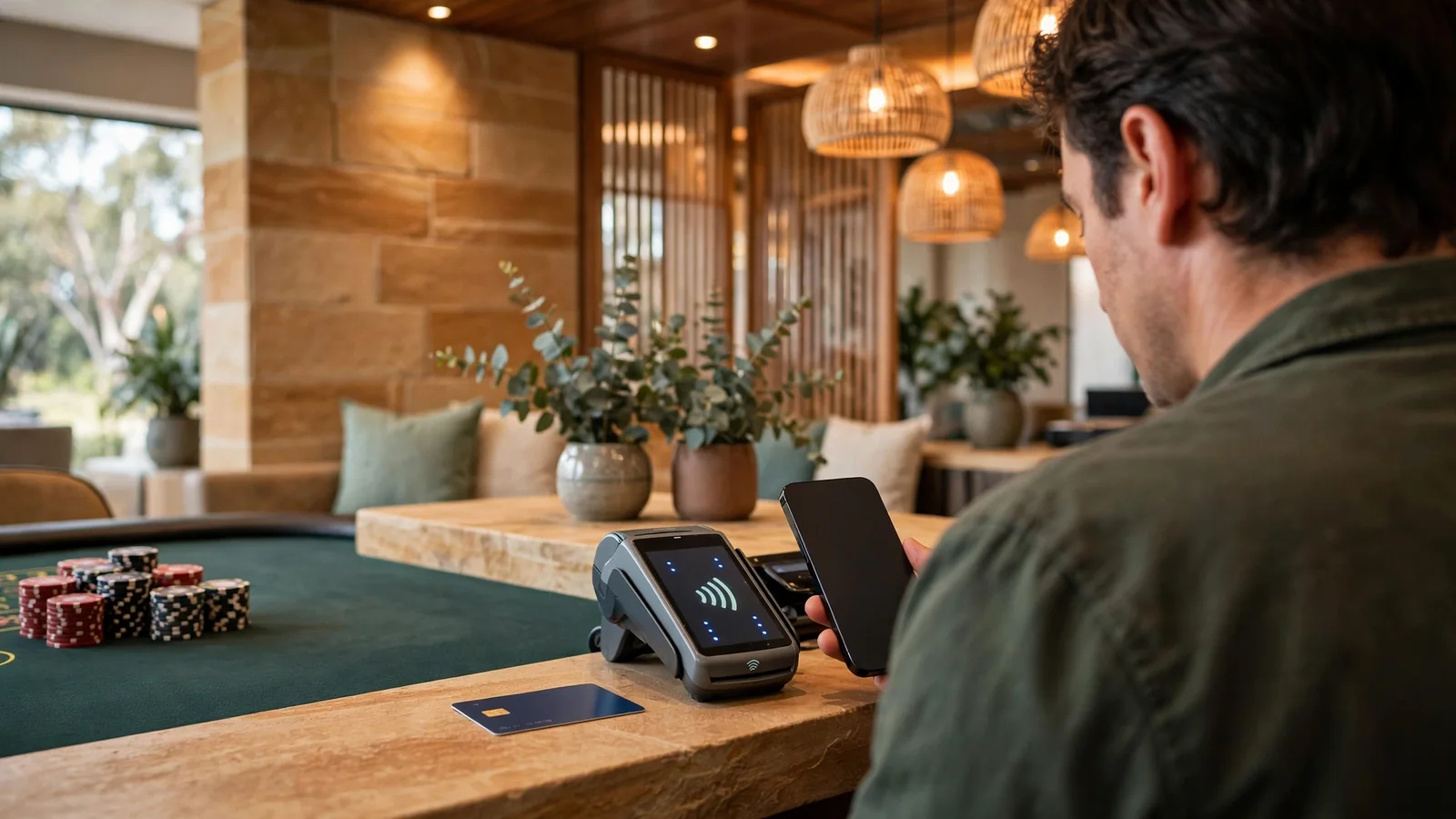
Australia is a card-and-phone-payment kind of place. Contactless credit and debit cards work at almost every point of sale, and mobile wallets such as Google Pay and Apple Pay are widely accepted too. Most people here are used to choosing between a card, a wallet, or a service connected to their bank, such as PayPal, depending on what they are paying for.
That familiarity can make switching payment services feel routine. I’ve done it myself: one option for a shop, another for a bill, and something else when a service has its own setup. But being comfortable with digital payments in general tells you very little about the options available at a particular website. A method that is common in everyday Australian transactions is not automatically supported by every online service.
MiFinity sits in that gap between general payment habits and a specific cashier’s choices. Australians may be accustomed to moving between payment tools, but that does not establish that a particular casino accepts MiFinity. Nor does seeing familiar alternatives elsewhere prove anything about MiFinity availability. Broad habits are context, not confirmation.
I used to treat a row of payment logos as a kind of answer. It isn’t. A logo can be outdated, apply only to certain customers, or simply fail to tell you whether a method is available for the action you have in mind. The useful question is not whether Australians commonly use digital payments; it is whether the service itself clearly states what it supports.
There’s also a bigger point that can get lost when the discussion narrows to payment convenience. Under the Interactive Gambling Act 2001, operators cannot provide real-money online casino games to people in Australia. The Australian Communications and Media Authority is responsible for enforcing that law, and Australian consumer law does not protect people who use offshore casinos.
So local payment habits can explain why a digital method feels familiar. They cannot turn familiarity into proof of acceptance, or make an offshore casino a protected option. Familiar isn’t verified.
A page can say that Australian online pokies accept MiFinity, and a payment logo can make that sound settled. It isn’t. A phrase on a page tells you what someone is claiming; it does not establish that the payment method works for Australian customers, or that the site is entitled to offer casino games here.
I’ve learned to treat payment badges as a starting point for checking, not as proof. A logo might be out of date, might refer to a different service, or might appear on a page that does not explain who can use the option. Even a clear statement that MiFinity is accepted leaves questions about the actual service and its terms. The label looks simple. The claim may not be.
That matters when you’re trying to work out whether an Australian online casino accepts MiFinity, or whether an Australian mobile casino listing applies to you. The wording can make a service sound local without showing that it is available to people in Australia. “For Australians” is not the same as evidence of lawful local provision, and a payment option does not change the rules for the gambling service itself.
There is a bigger issue than the wallet. Under the Interactive Gambling Act 2001, operators cannot provide real-money online casino games to people physically in Australia. That prohibition covers casino-style services, including pokies. The Australian Communications and Media Authority enforces the Act. It is the operator’s provision of the service that the law targets; the Act does not explicitly make a player’s use of an offshore site a criminal offence.
Still, that distinction should not be mistaken for protection. Australian consumer law does not protect people using offshore casinos. If something goes wrong with an account or a payment, you should not assume that the usual local consumer safeguards will apply. A site’s claim to accept MiFinity cannot fill that gap.
I used to read “Australian” as if it meant the service had been checked for Australian customers. It can simply be a label aimed at that audience. Likewise, a page titled around MiFinity and pokies may be describing a claimed payment route, not proving that the route is available or that the gambling service can legally be offered here. That is an important difference.
When checking a claim, look for what the page actually says, rather than relying on its headline or a row of logos. Does it clearly identify MiFinity as a current payment option for Australian customers? Does it explain any conditions, and are those details consistent across the relevant terms and payment information? If the wording is vague, contradictory or hard to find, don’t treat the logo as confirmation. A payment method can also be mentioned in general information without being available for every customer or service.
None of those checks makes an offshore casino lawful in Australia. They only help you interpret what a page is claiming. That distinction is easy to lose when a page uses confident words such as “accepted,” “available” or “best.” Those are descriptions, not proof on their own—and they do not change the legal position.
It is also worth separating a MiFinity claim from the broader question of whether a site offers casino games to Australians. Evidence for one would not establish the other. A payment mark cannot verify a game offering, and a game-related page cannot by itself confirm payment acceptance. Treat each statement on its own terms, and don’t let one label stand in for the rest.
So if a page says that MiFinity works at Australian online pokies sites, read that as a claim to scrutinise, not a recommendation or a guarantee. The careful conclusion is not that a particular site has been confirmed; it is that a logo or headline alone cannot settle the matter. And even clear payment wording does not remove the legal and consumer-protection risks of offshore casino services in Australia.
No shortcut here.
A deposit claim can sound settled when it is only a label on a page. “MiFinity deposits accepted” looks decisive; what it really tells you is that someone has made a claim. It does not, by itself, establish that a payment can be made from Australia, that the option is available to every account, or that the cashier will accept a transaction when you reach it.
I have learned to slow down at this point. A payment logo can make a service feel ready to use, but it is not the same as a working deposit route. Nor does a page that mentions MiFinity necessarily show the conditions that matter before money moves. Those details need separate confirmation.
For a casino deposit by MiFinity to be more than a phrase, the relevant details would need to be clear and current: whether the method is available to Australian customers, whether the cashier offers it for deposits, and what conditions apply to using it. A general mention of MiFinity cannot answer all of those questions.
The same goes for a page describing a casino with MiFinity deposits. The wording may refer to a past arrangement, a feature available only in some circumstances, or an option that is not available to Australian residents. Without clear, current terms, it is not a reliable basis for deciding that a deposit can be made.
I would also separate the payment method from the amount. A search for a small fixed deposit does not prove that a site accepts that amount, or that it has any particular minimum. A number in a headline or promotional snippet is not a substitute for terms that explain what applies to your account.
No amount assumed.
Processing time needs the same care. A deposit description may use words such as “quick” or “instant”, but those labels do not establish how long a MiFinity transaction takes. If a payment is delayed, the copy on a page will not tell you what happened or when the money will be available.
That uncertainty matters before any payment details are entered. Do not treat a casino deposit via MiFinity as a tested route merely because the method appears in a list. A payment option might be described without explaining its availability, requirements, or handling. If those particulars are missing or unclear, the practical answer is not to fill in the gaps yourself.
There is a more basic issue than deposit terms. Under the Interactive Gambling Act 2001, operators are prohibited from providing real-money online casino games to people in Australia. The Australian Communications and Media Authority enforces that law. The restriction concerns operators; it does not make a payment-method claim proof that a service is lawful or available to Australian residents.
Australian consumer law also does not protect people using offshore casinos. That leaves you without the local consumer protections you might expect if a payment dispute arises. I would not read a polished cashier page as a safety net.
So, if you are trying to establish whether a MiFinity deposit is available, the sensible threshold is clear, current information that explicitly applies to Australian customers. If that cannot be confirmed, do not treat a broad claim as permission to proceed. And even a clear statement about payment availability would not change the legal position for online casino services offered to people in Australia.
It is easy to get caught up in searching for a site that accepts MiFinity deposits and miss the more useful question: what exactly is being promised, and to whom? “Available” can mean different things unless the terms spell out the customer location and transaction conditions. A copied logo or a loose mention is thin evidence.
My old mistake was treating a payment badge like a working checkout. It is not. If the details are not explicit, pause rather than guessing.
A page can say that a casino accepts MiFinity without showing what that means in practice. I’ve learned not to treat a payment logo or a confident headline as confirmation. It may be old, copied from another page, or refer to a service that is not available to Australian users. A claim is a starting point, not proof.
For casinos said to accept MiFinity in Australia, look for evidence tied to the specific operator and the current cashier. The important distinction is between a general statement on a review page and an operator’s own, up-to-date payment information. Even then, a logo on a site does not establish that the method is available to every visitor or that the operator can lawfully serve people in Australia.
There’s a bigger issue than the payment method. Under the Interactive Gambling Act 2001, operators must not offer online casino games to people in Australia. The Australian Communications and Media Authority (ACMA) is responsible for enforcing that law. The Act does not explicitly make players’ use of offshore sites a criminal offence, but that should not be mistaken for approval or protection.
Australian consumer law does not protect people who use offshore casinos. If an operator refuses access, disputes a payment, or fails to resolve a complaint, you should not assume local consumer protections will apply. That is a real downside, not fine print.
I used to read “accepted” as though it meant the whole arrangement had been checked. It doesn’t. It tells you only what someone claims about a payment method, and even a genuine acceptance claim cannot settle whether the service is lawful for Australian residents or what recourse you would have. Keep those questions separate. Less guesswork.
If you’re looking for casinos that accept MiFinity in Australia in 2026, use this list as a starting point and check each casino’s cashier for current availability before depositing. The details below highlight the limited operator information available to help you decide what to verify.
LuckyVibe
LuckyVibe is listed with a Curacao Gaming Control Board licence, OGL/2023/176/0095, held by Hollycorn N.V.
Vegaz Casino
Vegaz Casino has a Curacao licence, OGL/2024/1335/0780, and a minimum deposit of EUR 20.
LevelUp Casino
LevelUp Casino is listed with a Curacao eGaming licence, OGL/2023/174/0082, held by Dama N.V. Its minimum deposit is A$15.
SkyCrown
SkyCrown lists a Tobique Gaming Commission licence and a minimum deposit of A$30. Its stated payout times are around 10–15 minutes for crypto and 1–5 days for fiat.
SpinsUp
SpinsUp is listed with a Curacao Gaming Control Board licence, OGL/2023/174/0082, held by Dama N.V.
JustCasino
JustCasino is listed with a Curacao Gaming Control Board licence.
Uptown Pokies
Uptown Pokies is listed as operating under a Curacao licence since 2017, with a minimum deposit of A$20.
Roby Casino
Roby Casino is listed with a Curacao eGaming licence held by Roby Games Ltd.
Ricky Casino
Ricky Casino lists a minimum deposit of A$20, or A$30 to qualify for the bonus. Its stated payout times are under an hour for crypto and 1–3 business days for PayID.
MrPacho
MrPacho lists a minimum deposit of A$30. Its stated payout times are 30–120 minutes for crypto and 24–72 hours for fiat.
“Best” sounds like a verdict. On a casino page, it can mean little more than a confident headline attached to a list. I’ve learned not to treat that word as evidence: a ranking can look tidy while leaving the important questions unanswered.
For someone in Australia, a MiFinity label does not tell you whether a site is suitable, lawful to use, or even genuinely set up to accept that payment method. So I won’t dress uncertainty up as a recommendation.
That distinction matters. A site may mention MiFinity in promotional copy, while the actual service and its terms remain unclear. Even a polished comparison page can repeat a claim without showing what it rests on. “Top pick” is just a label unless the basis for the judgement is plain and checkable. And if the evidence does not establish the basic premise, a star rating cannot fix it.
Suitability also means more than whether a payment logo appears. You would need reliable information about who runs the service, what rules apply, how personal information is handled and what happens if there is a dispute. A vague ranking cannot answer those questions for you. Nor does a payment method, by itself, make an operator trustworthy.
There is a larger issue for Australian readers. Under the Interactive Gambling Act 2001, it is illegal for operators to offer real-money online casino games to people physically in Australia. The Australian Communications and Media Authority enforces the Act. Australian consumer law does not protect people using offshore casinos, so a reassuring-looking “best” badge is no substitute for local consumer protections. I would not read an offshore ranking as an endorsement or as a sign that a service is legally available here.
It is easy to focus on the neat parts: a comparison table, a payment logo, a short verdict. The hard part is what those elements leave out. Who checked the claim? Is the information current? Does the page explain its limits, or does it turn uncertainty into a smooth sales pitch? If those answers are missing, the ranking may tell you more about the page than about the service.
I’ve been caught by presentation before. A confident label can make a choice feel settled before you have established what is actually being offered. That is a bad moment to hand over personal or financial details. With MiFinity-related casino claims, the sensible conclusion is not that one site outranks another; it is that a ranking cannot create evidence that is not there.
So “best MiFinity casino” should not be treated as a reliable category for Australian residents. Keep the claim separate from the conclusion. A headline can say “best”; it cannot prove suitability.
A payment method and a site’s games are two different things. Seeing MiFinity mentioned beside a casino does not tell you what that site offers, and a page describing games does not prove MiFinity can be used to pay. I used to treat those details as one package. They aren’t.
For an Australian reader, that distinction matters even before considering a payment screen. Under the Interactive Gambling Act 2001, operators cannot provide real-money online casino services to people physically located in Australia. The Australian Communications and Media Authority enforces the Act. Australian consumer law also does not protect people using offshore casinos, so a familiar payment name should not be mistaken for a local safeguard.
A MiFinity reference can mean several things: a general description of the service, a logo in a payment-method graphic, or a statement about a particular operator. Those are not interchangeable. Even a genuine statement that a site accepts a payment method would establish only something about payment acceptance; it would not confirm the site’s games, or make its services lawful to offer in Australia.
The reverse is just as important. A page mentioning casino games alongside MiFinity may simply be putting two topics together. It does not show that those games can be paid for with MiFinity, or that the operator supports the service for Australian users. The wording can look definite while leaving the practical point unclear.
I now separate the questions rather than letting a logo answer all of them:
That last check is not fine print. Casino-style online gambling services are prohibited for operators serving people in Australia, and offshore use does not bring Australian consumer-law protection with it. A payment brand cannot change that.
So, when you see MiFinity and casino games presented together, don’t read the pairing as proof of a working payment route or a particular game selection. They are separate claims, and neither establishes the other. Keep them separate.
Seeing MiFinity mentioned beside a casino does not tell you whether it is available as a payment option. The cashier is where a site would show the methods it actually supports, but even a familiar-looking logo can be out of date or refer to a different service. I’ve learned not to treat a payment badge as a promise. It’s only a prompt to check.
For anyone wondering whether they can pay with MiFinity, the important distinction is between the name appearing somewhere on a site and the cashier offering it for your account and location. A general statement about payment options may not settle that. Nor does the fact that you use MiFinity elsewhere mean a gambling operator will accept it.
That uncertainty is not a reason to try different routes around a declined payment. Don’t enter payment details unless you understand who is handling the transaction and what the cashier says before you submit. If the method is not clearly offered, there is no sound basis for treating it as accepted. Simple as that.
There is a larger issue for people in Australia. Under the Interactive Gambling Act 2001, operators must not provide real-money online casino games to people physically located in the country. The Australian Communications and Media Authority enforces that law. Australian consumer law does not protect people who use offshore casinos, either. A payment option being displayed would not change those points or make the service lawful for operators to offer here.
So, if you come across a claim that a casino takes MiFinity, read it as a claim—not proof that its cashier supports the method or that using the service is protected. I wouldn’t build a payment decision around a logo, a search result or wording copied from an old page. The practical answer depends on what the cashier actually displays, and that alone cannot resolve the legal or consumer-protection risks. No shortcut.
A payment method appearing beside deposits does not establish that it can receive withdrawals. Those are separate functions, and a cashier may describe one without explaining the other. So a reference to MiFinity for adding funds is not proof that winnings could be sent back through MiFinity.
For a MiFinity withdrawal, the details that matter are the actual route, any account or identity conditions, and the time the operator says a transfer takes. I would not fill the gaps with another payment method’s rules or assume that a familiar e-wallet works the same way.
I used to read a payment logo as if it answered every question. It doesn’t. A deposit method and a withdrawal method can be treated differently, and a general payment list may not spell out either process clearly. Until the terms explicitly describe withdrawals through MiFinity, the honest answer is that the route and timing are unknown. No guesswork.
There is also a bigger issue than the cashier. Under Australia’s Interactive Gambling Act 2001, operators cannot provide real-money online casino games to people in Australia, and the Australian Communications and Media Authority enforces that law. Australian consumer law does not protect people using offshore casinos. A payment option being mentioned does not make an offshore service lawful or give you local consumer safeguards.
If you encounter a claim about a casino withdrawal through MiFinity, read it as a claim to check, not as proof that deposits and payouts use the same path. Look for explicit withdrawal terms rather than relying on a logo or a generic list of payment methods. If the wording only discusses deposits, it has not answered the withdrawal question.
That distinction matters for searches about MiFinity withdrawals from pokies sites in Australia too: the phrase itself tells you what someone wants to know, not whether a withdrawal route exists. Don’t treat “available” as a complete answer unless the terms say what it applies to.
“Instant” sounds clear until you try to pin down what it means. It might describe how quickly a payment request is handled, not when the money is available to you. I’ve learned not to treat that word as a payout schedule. A claim about a fast MiFinity withdrawal does not tell you what happens after you request one, or when you could actually use the funds.
There is another step worth keeping in view: online casinos commonly ask customers to complete Know Your Customer checks before carrying out financial transactions. That means identity verification can be part of the process before money moves. It is useful context when you see a promise of speed, but it does not establish how a MiFinity withdrawal would be checked or timed.
I used to read “instant” as a firm promise. It isn’t. The word alone leaves too much unanswered: whether a request is reviewed first, whether your account details need checking, and what the payment provider’s role is. Without clear terms for the specific transaction, there is no sound basis for turning a speed label into an expectation.
The same goes for wording that pairs MiFinity with real-money pokies or calls a site new. Neither description tells you how a payout works. Nor does adding “no deposit” to a promotion phrase make the withdrawal timing clearer. A payout claim and the conditions attached to an offer are separate things; don’t let one suggest more than it says.
Before relying on a speed claim, read the withdrawal terms and the cashier information carefully. Look for an explanation of verification, any review stages, and the stated timing for a completed withdrawal. If the wording is vague, ask the operator for a direct answer before making a decision. A logo or a bold headline is not a timetable.
There is a more important issue for people in Australia. The Interactive Gambling Act 2001 makes it illegal for operators to provide real-money online casino games to people physically located in Australia. The Australian Communications and Media Authority enforces that law. Australian consumer law does not protect you when you use an offshore casino, so a confident payout promise should not be mistaken for protection if something goes wrong.
I know how tempting it is to focus on the quickest route and skip the fine print. That’s how a neat-sounding claim can become an expectation the terms never supported. Keep “instant” in quotation marks until you have a specific, understandable explanation of the process—and consider the legal and consumer risks before engaging with offshore casino services. Speed is not certainty.
A bonus advertised alongside MiFinity can sound like a neat two-for-one: use the payment service, get an offer. I’ve learned not to treat that wording as a promise. A page can mention a payment method and a promotion without explaining whether they are connected at all.
For a MiFinity bonus to mean anything, the terms would need to say what qualifies, which payment methods count, and what conditions apply. “Exclusive” is just a label until the actual terms back it up.
That is separate from whether a cashier accepts MiFinity. Even if a payment method were accepted, that would not establish bonus eligibility. And a bonus mention does not prove the payment method works. Keep those claims apart.
There is also a bigger Australian context. The Interactive Gambling Act 2001 makes it illegal for operators to provide real-money online casino games to people in Australia, and the Australian Communications and Media Authority enforces the law. Australian consumer law does not protect people using offshore casinos. A promotion does not change that.
I’d avoid making a money decision based on a banner or a short line beside a payment logo. Read the full terms before relying on any offer, and don’t assume that a MiFinity payment qualifies just because the two appear on the same page. No shortcut.
Check the casino’s cashier for American Express and confirm that it is available for your account. Your card issuer may still block a gambling transaction.
Look for American Express as a deposit option in the casino’s cashier. A payment logo alone does not confirm that the option is available to you.
Yes. Each casino sets its own Amex deposit and withdrawal limits, so check the limits shown in its cashier or payment terms; they can vary between casinos.
Amex deposits are typically free, but a casino may charge a 1.5% transfer surcharge, and a 3% currency-conversion fee may apply. Withdrawals may also incur a fee.
Some casinos allow Amex withdrawals, but not all do, and you generally need to have deposited with Amex first. A withdrawal can take up to five days to clear and may incur a fee.
Yes, at a casino that accepts American Express, but the gift card can be used for deposits only, not withdrawals.
Prepared by the Richard Casino editorial staff.