PayID can move funds in real time after release, but casino approval, verification, limits and wagering rules can affect the full cashout.

“Instant” sounds simple: request a withdrawal and see the money arrive straight away. The snag is that it can describe only one part of the journey. PayID is Australia’s bank-to-bank payment system, operating through the New Payments Platform (NPP). Transfers through the Osko network are processed in real time. That describes the movement of funds between accounts—not how quickly an operator decides to release them.
I used to read “instant payout” as a promise about the whole process. It isn’t. A withdrawal has at least two distinct stages: the operator’s handling of the request, then the payment itself. The first stage is controlled by the operator. The second is where PayID’s real-time capability matters. If you blend those steps together, the advertising phrase can make a slow approval look like a slow bank transfer, or make a fast payment sound like immediate access from the moment you click.
A specialist review reports that funds can move instantly through PayID once the casino releases a withdrawal. The key words are “once the casino releases it”. Before that handoff, the request is still with the operator. So “instant” does not mean the account receives money at the same moment a withdrawal is requested. It means the payment rail can transfer money in real time after the release.
If you’re looking for instant PayID withdrawals in Australia, check the stated payout details carefully: a PayID option does not by itself confirm an instant transfer. Use this list as a reference to the information available for each operator.
LuckyVibe
You can note LuckyVibe’s listed licence: Curacao Gaming Control Board OGL/2023/176/0095, held by Hollycorn N.V. No PayID withdrawal speed is provided here.
Vegaz Casino
Vegaz Casino is listed with Curacao licence OGL/2024/1335/0780 and a minimum deposit of EUR 20. No PayID withdrawal timing is provided.
LevelUp Casino
You can consider LevelUp Casino’s listed Curacao eGaming licence, OGL/2023/174/0082 (Dama N.V.), and its A$15 minimum deposit. PayID withdrawal speed is not specified.
SkyCrown
SkyCrown lists crypto payouts at around 10–15 minutes and fiat payouts at 1–5 days, alongside a A$30 minimum deposit. The stated timing does not specify instant PayID withdrawals.
SpinsUp
SpinsUp is listed with Curacao Gaming Control Board licence OGL/2023/174/0082, held by Dama N.V. No PayID withdrawal speed is provided.
JustCasino
JustCasino is listed with a Curacao Gaming Control Board licence. No PayID withdrawal timing is provided.
Uptown Pokies
Uptown Pokies is listed as operating since 2017, with a Curacao licence and an A$20 minimum deposit. No PayID withdrawal speed is specified.
Roby Casino
Roby Casino is listed with a Curacao eGaming licence held by Roby Games Ltd. No PayID withdrawal timing is provided.
Ricky Casino
Ricky Casino lists PayID payouts at 1–3 business days and crypto payouts in under an hour. Its minimum deposit is A$20, or A$30 to qualify for the bonus, so the stated PayID timing is not instant.
MrPacho
MrPacho lists crypto payouts at 30–120 minutes and fiat payouts at 24–72 hours, with a A$30 minimum deposit. No specific PayID withdrawal speed is provided.
That distinction is worth keeping in mind whenever you see an instant PayID withdrawal claim in Australia. The wording may refer to the transfer leg, not the complete time from request to receipt. The two can be very different. A real-time network cannot make an operator approve a request in real time; it can only carry the payment after approval.
I’d also separate “PayID” from the bank details themselves. PayID is the payment service, while the NPP is the infrastructure that enables participating banks to send transfers between accounts. Osko is the network through which the transfer is processed in real time. These names are often packed together in payment descriptions, but they point to the rails and services involved—not to the operator’s internal decision-making.
Here’s the plain version: operator approval first, bank-to-bank transfer after. If approval has not happened, there is no released payment for the network to move. Once it has happened, the PayID transfer can be real time. That is the whole meaning of “instant” in this context. No magic button. Just two separate stages.
There is also an important legal context for Australian readers. Under the Interactive Gambling Act 2001, operators are prohibited from providing real-money online casino games, including slots and table games, to people physically located in Australia. This explanation is about what payment terminology means, not a recommendation to use an online casino or a claim that such services are lawful to provide here.
When a phrase like “instant PayID payout” catches your eye, read it as a description of payment capability, not a guarantee about the entire withdrawal. PayID can support a real-time transfer. The word “instant” does not erase the operator’s role before the money is sent.
That’s the distinction.
The word “instant” looks clear until you check what the clock is measuring. A payout claim might describe the time between approval and funds arriving, or it might imply the whole withdrawal journey is immediate. Those are different things. I’ve learned not to treat a bold label as a timing guarantee.
A specialist review reported average withdrawal times of 30–90 seconds for some PayID casino options. That is a reported result, not a dependable benchmark for every player or every request. Another review described sites advertising “instant” withdrawals where internal review meant the process took as long as 24 hours. Both accounts point to the same problem: a headline can leave out the conditions that shaped the result.
When you read a claim, look for the explanation beneath it. Does it say when timing starts and stops? Does it distinguish the operator’s handling from the bank transfer? Does it explain whether the result reflects a particular test or applies more broadly? If the wording gives no method or qualification, I would treat it as marketing, not a promise.
Be wary of phrases that blur those stages together. “Paid instantly” may sound like a withdrawal request goes straight to your account, but a casino can still review a request before releasing it. The speed of the payment network does not tell you how long an operator will take to approve a transaction. Neat slogan. Missing detail.
I’d also compare the claim with the written withdrawal terms rather than relying on a banner or a short promotional line. If those terms describe review or processing conditions that the headline skips, the detailed wording matters more. Save a copy of the relevant terms when you check them; promotional pages can change, and it is useful to know what was actually stated.
There is a more basic point for people physically in Australia: the Interactive Gambling Act 2001 prohibits operators from providing real-money online casino games, including slots, to customers here. A payout-speed claim should not be read as an endorsement or an invitation to use such a service. The legal position matters more than a fast figure.
So, when you see “instant,” ask what the claim covers, who reported the timing, and whether the terms support the impression it creates. If those details are missing, the honest reading is simple: the wording makes a claim, but it does not establish what will happen to an individual withdrawal.
When a payment method is used to fund an account, the operator may expect a withdrawal to go back through that same route where possible. With PayID, that means the details used to deposit should match the details entered for a withdrawal. Treating a different PayID as an interchangeable shortcut can prompt a security review and hold up the request.
It is an easy detail to overlook. You may have access to more than one bank account or PayID, and the one that seems most convenient at cashout may not be the one connected to your original payment. Before confirming a transaction, check which PayID you used to deposit and whether the withdrawal details match. A mismatch does not automatically mean a payment will fail, but it can leave the operator needing to check that the request is legitimate.
This is separate from the bank transfer itself. A payment method can support real-time transfers, but that does not remove checks made by the operator or guarantee that a withdrawal request will be approved immediately. “Instant” describes the payment leg after release; it is not a promise that every request moves from submission to receipt without review.
If the details do not match, do not keep submitting requests with different identifiers and hope one goes through. Read the operator’s payment terms and ask its support team what information is needed to resolve the mismatch. The operator may require the funds to be returned through the original method where that is possible. Follow the instructions for the account linked to your profile rather than trying to route money through someone else’s details.
I would also keep a note of which payment details I used. Not a complicated spreadsheet—just enough to avoid relying on memory when it is time to request a withdrawal. That small check can prevent a simple inconsistency from turning into a longer back-and-forth.
This is practical payment information, not a recommendation to use an online casino. Real-money online casino games, including slots and table games, are prohibited for operators to provide to people in Australia under the Interactive Gambling Act 2001. If you are reviewing payment terms, make sure you understand what the operator says about returning funds to the original method and how it handles a mismatch. Don’t assume that a displayed PayID option means every account detail will be accepted for both directions.
The basic rule is straightforward: use the same PayID details for deposits and withdrawals, and make sure they belong to the account linked to your profile. It may not eliminate every check, but it avoids creating an avoidable reason for one. A small detail, with consequences.
A payout can arrive without delay and still leave you with less than expected if the terms set a fee or restrict how much can be withdrawn. When reviewing PayID terms, I’d separate three things: the minimum cashout, the maximum for a single transaction, and any cap that applies over a longer period. They answer different questions.
A specialist review reported that reputable PayID services make their minimum and maximum withdrawal limits clear. Treat that as a useful standard to look for, not a guarantee about every operator. If the terms do not state the limits plainly, or the figures differ between the cashier and the terms page, do not assume the higher amount will be honoured. The casino’s own published policy governs what it will process.
The single-transaction maximum is only part of the picture. A separate weekly or monthly cashout ceiling may apply, according to a specialist review of payment terms. That can affect how much you can receive during the relevant period even when an individual request is within its permitted range. Check how the period is defined and whether the cap covers all withdrawal methods together or PayID requests specifically. If the wording leaves that unclear, ask support to explain it before relying on a particular amount.
Fees deserve the same attention. A report by filmink.com.au notes that a fee may apply when withdrawing through PayID. That does not establish that every PayID cashout is charged; it means you should look for the fee schedule and confirm whether any charge is taken from the requested amount or added separately. A small fee can matter more when you make several separate withdrawals, so compare the cost of one permitted cashout with the cost of splitting it up.
Filmink.com.au also reports that casino policy may limit withdrawal amounts. Read the relevant terms before making a decision, rather than relying on a banner that promotes an “instant” payout. A speed claim tells you nothing about the amount the operator will approve or any deduction attached to it.
I learned to read the cashier and the terms together, not just the first figure I saw. Look for minimum and maximum amounts, any rolling weekly or monthly cap, and PayID-specific fees. Save the wording or take a screenshot: if the amount shown at cashout does not match the published policy, you have a clear point to raise with support.
The important distinction is simple: the amount you request is not necessarily the amount the terms allow you to withdraw in one go, and the amount approved may not be the amount credited if a fee applies. Check those conditions before treating a displayed balance as cash you can receive. No assumptions.
When I compare payment methods, I separate two things: how long the operator takes to approve a withdrawal, and how long the payment itself takes to reach you. The method matters, but it does not tell the whole story. A fast transfer route cannot make an operator’s review disappear.
PayID is linked to Australia’s New Payments Platform, which supports real-time bank-to-bank payments. That gives it a timing advantage once a payment is sent. But “instant” describes that transfer stage, not necessarily the full period from submitting a withdrawal request to seeing the money in your account.
PayPal and Skrill are among the e-wallets Australian players may encounter, although available methods vary between services. An e-wallet can be quicker than a card or conventional bank transfer, but published timings are not consistent enough to treat as a promise. One specialist review reports that e-wallet withdrawals are often completed within hours rather than days; another general timing estimate puts them within a day. Those are reported expectations, not a deadline you can rely on for every operator or transaction.
There is a practical trade-off, too: receiving money in an e-wallet may involve a further step if you want it in your bank account. I would compare the full route, not just the moment the balance appears in the wallet.
Credit and debit cards are also listed among methods Australian players may find. Card withdrawals may take several days, according to a general comparison of payment timings. A card that works for adding funds should not be assumed to offer the same route in reverse; the available withdrawal options depend on the service’s terms.
That difference can be easy to miss when you are focused on how quickly a deposit goes through. Deposit speed and cashout speed are separate questions.
Traditional bank transfers can take longer than a real-time payment route. A specialist review gives a possible completion period of as many as five business days, while another comparison describes bank transfers as taking several days. Treat those as reported timings, not a universal schedule: the route and the operator’s handling both matter.
Some services also list cryptocurrency, but availability is not universal, and a quick transfer claim does not by itself tell you how long the entire withdrawal will take.
If timing is your main concern, PayID has the clearest advantage at the bank-transfer stage. E-wallets may also be relatively quick, while card payments and traditional transfers can take longer. Still, I would not choose by a single advertised speed figure. Check which methods are actually available, what timing the terms attach to each one, and whether that timing refers to approval or to the payment reaching you.
Supports real-time bank-to-bank transfers via the NPP, offering the clearest timing advantage at the transfer stage.
Often completed within hours or a day, though they may require an extra step to move funds to a bank account.
Typically the slowest options, with traditional bank transfers potentially taking up to five business days.
The wording matters. “Fast” can describe one leg of the trip. The whole journey is another thing.
The useful distinction is between a withdrawal being approved and the money travelling to your bank. PayID addresses the second part. It runs through Australia’s New Payments Platform, which enables real-time transfers between bank accounts. Once an operator releases a payment through PayID, the bank-to-bank leg can be near-instant.
That is not the same as getting money instantly from the moment you press “withdraw”. Your request first has to move through the operator’s process. Until it is approved and released, the funds have not started their PayID journey. The payment network cannot speed up a request that is still waiting on the casino’s side.
I find it helps to picture two separate clocks. The first measures how long the withdrawal request takes to reach release. The second measures the transfer after release. PayID can make the second clock very short; it does not control the first. That small distinction is where a lot of “instant” wording gets slippery.
A report on filmink.com.au contrasts almost-instant PayID withdrawals with traditional bank transfers that can take several working days. Read that as a comparison of payment routes, not a promise that every request will be completed at the same pace. A bank transfer may involve a slower route after release, while PayID’s design supports real-time movement between participating accounts.
So if a balance changes to “processing” or “pending”, that status matters more than the payment method’s reputation. It tells you the operator has not necessarily handed the money over yet. Once the withdrawal is marked as paid or released, the relevant question changes: has the bank received the transfer? Those are different stages, even when the screen makes them look like one transaction.
I used to treat a fast payment method as if it meant a fast cashout from start to finish. It does not. PayID is the quick handoff, not a shortcut through every step before it. “Instant” describes the transfer leg.
For a clear account of what is happening, check the withdrawal status and the operator’s stated processing terms separately. If the request has not been released, waiting for the bank to display the funds is premature; the money is still with the operator. If it has been released, the PayID transfer is the part designed to move promptly, though the exact experience can still depend on the banks involved.
One legal point should not be blurred by payment terminology: real-money online casino games are prohibited from being provided to people in Australia under the Interactive Gambling Act 2001. A description of how PayID works is not an endorsement or an invitation to use such services. The mechanics are straightforward; the wording around them is not always so.
The word “instant” can make it sound as though the money moves the moment you press confirm. That is not what it guarantees. A withdrawal has more than one stage: the operator may need to review the request before releasing it, and the bank transfer happens after that. PayID cannot skip the first stage.
I used to treat a payment label as a stopwatch. That was a mistake. A specialist review reported that some sites advertised instant withdrawals but took as long as 24 hours when internal review was involved. That is one reported case, not a timetable you can rely on across operators. The useful point is the distinction: an instant payment method does not mean an instant decision.
A first cashout may prompt identity checks, or a request may be held for a closer look at account or payment details. These checks are separate from PayID’s transfer network. If the operator has not approved and released the funds, there is nothing for the bank to receive yet.
This is why two withdrawals made with the same payment method can take different amounts of time. One may pass through without additional review; another may need a person to examine it. “Instant” describes the payment stage, not the operator’s queue.
A specialist review identified withdrawals over $2,000 as one possible cause of delay. That does not mean every request above that amount will be held, or that smaller requests cannot be checked. It means the amount can be one factor in an operator’s review process.
Some operators may also release a large withdrawal in instalments under their own policy. In that situation, the first payment reaching an account does not necessarily mean the full request has been completed. The terms should explain how releases are handled.
After an operator releases the funds, bank-side handling can also affect when they appear. A specialist review listed bank processing windows among common reasons for delays. A transfer may therefore be approved without showing in your account at once.
If a request is taking longer than the stated processing window, check whether it is still marked as pending or has been released. Those statuses point to different stages, so they help narrow down where the wait is happening. Contact the operator about a pending request; if it is marked as sent, ask your bank whether it can see the incoming transfer.
The short version: a delay does not automatically mean PayID failed. It may be operator review, the withdrawal amount, or bank handling after release. “Instant” is not a promise that every step—from request to receipt—happens immediately.
Identity checks are part of withdrawal processing, not a shortcut around it. A real-money online casino cannot legally provide its games to people physically located in Australia, so this is general information about how verification is described by offshore operators—not a recommendation to use one.
A casino must verify a player’s identity through KYC procedures before processing a withdrawal. The first cashout is often when an operator asks for documents, according to specialist reviews of casino withdrawal processes. That can catch people off guard: they submit a request expecting the payment to move, then discover that the operator has paused it while checking their details.
Verification Process
Submit Documents
Upload identity and account information through the operator's secure submission channel.
Await Approval
Wait for the operator to review the images and details to ensure they are not blurry or expired.
Confirm Status
Check the account verification area to ensure documents have been accepted before requesting a withdrawal.
I’ve learned to treat “verified” as a status worth checking before relying on any advertised payout time. If an operator offers an account verification area, read its instructions and confirm whether your documents have been accepted. Uploading files is not the same as having them approved. A blurry image, expired document or mismatch in account details can mean another round of messages and waiting.
The usual purpose of KYC is to establish that the account belongs to the person using it. The operator may ask for documents that show identity and other account information. Follow the specific instructions given rather than sending extra personal material unprompted, and use only the operator’s stated secure submission channel. Keep a note of what you submitted and when, so you can answer a follow-up clearly instead of starting from scratch.
Completing verification early can significantly speed up later withdrawals because the operator has already completed that identity check. It does not guarantee that every future request will be cleared without review, and it cannot turn the whole process into an instant payment. But it can remove one avoidable hold-up from a later cashout.
I would also check that the name and details on the account match the documents. If something is wrong, contact support through the official account channel before making a withdrawal request. Guessing at a correction or opening another account can create more questions rather than resolve the original one.
Keep expectations grounded. “Instant” may describe the payment step after approval; it does not mean a new account is automatically verified, or that a request bypasses identity checks. An operator’s terms should explain what verification it requires and how documents are submitted. If those instructions are unclear, that is a reason to pause—not a reason to send sensitive documents through an unofficial contact.
For anyone in Australia, there is a larger point before getting to payment mechanics: the Interactive Gambling Act 2001 prohibits operators from providing real-money online casino games to people located here. No payout feature changes that legal position. If you have already shared identity documents with an offshore service, be cautious about further requests and protect your personal information. Verification can make a later transaction smoother, but it is not a guarantee of access, approval or payment.
Before requesting a withdrawal, check whether any bonus attached to your pokies play still has wagering conditions outstanding. A PayID payment method does not make funds eligible to cash out: if the offer’s rules require more qualifying play, a withdrawal request may be restricted until those requirements are met. I’d check this before treating the balance on screen as money I can take out. A displayed balance can include funds that are still subject to conditions.
The detail that matters most is what the wagering requirement applies to. It may cover the bonus funds alone, or it may apply to the combined deposit and bonus. A specialist review of bonus terms notes that both structures exist and regards bonus-funds-only wagering as the more favourable arrangement. The difference is practical: when the deposit is included, more of your balance may be tied to the requirement than when the rule applies only to the bonus.
Read the offer’s own terms rather than relying on a short banner or a button that says “claim”. Look for wording that identifies the wagering base, states which games count, and explains when the restriction ends. If the terms do not make clear whether your deposit is included, do not assume the narrower interpretation. Ask the operator to clarify the rule before accepting the offer.
Also check whether the bonus is optional. If you do not want its conditions, declining it may avoid attaching wagering rules to the play. If you have already accepted it, check the account’s bonus or promotion area for the remaining requirement and any relevant status before submitting a cashout. Keep a copy of the terms that applied when you opted in; promotions can have their own conditions, and a later page may not tell you what you originally agreed to.
I’ve learned not to confuse “available balance” with “withdrawable balance”. The wording can look reassuring while the offer rules still control what happens next. If a request is blocked, check the wagering status and the bonus terms first, rather than assuming the PayID details are the cause.
For anyone in Australia, this is general information about how wagering conditions can affect a withdrawal, not an invitation to use a real-money online casino. The Interactive Gambling Act 2001 prohibits operators from providing online casino games, including slots, to people physically located in Australia. Be clear on the legal context as well as the offer conditions. No shortcut.
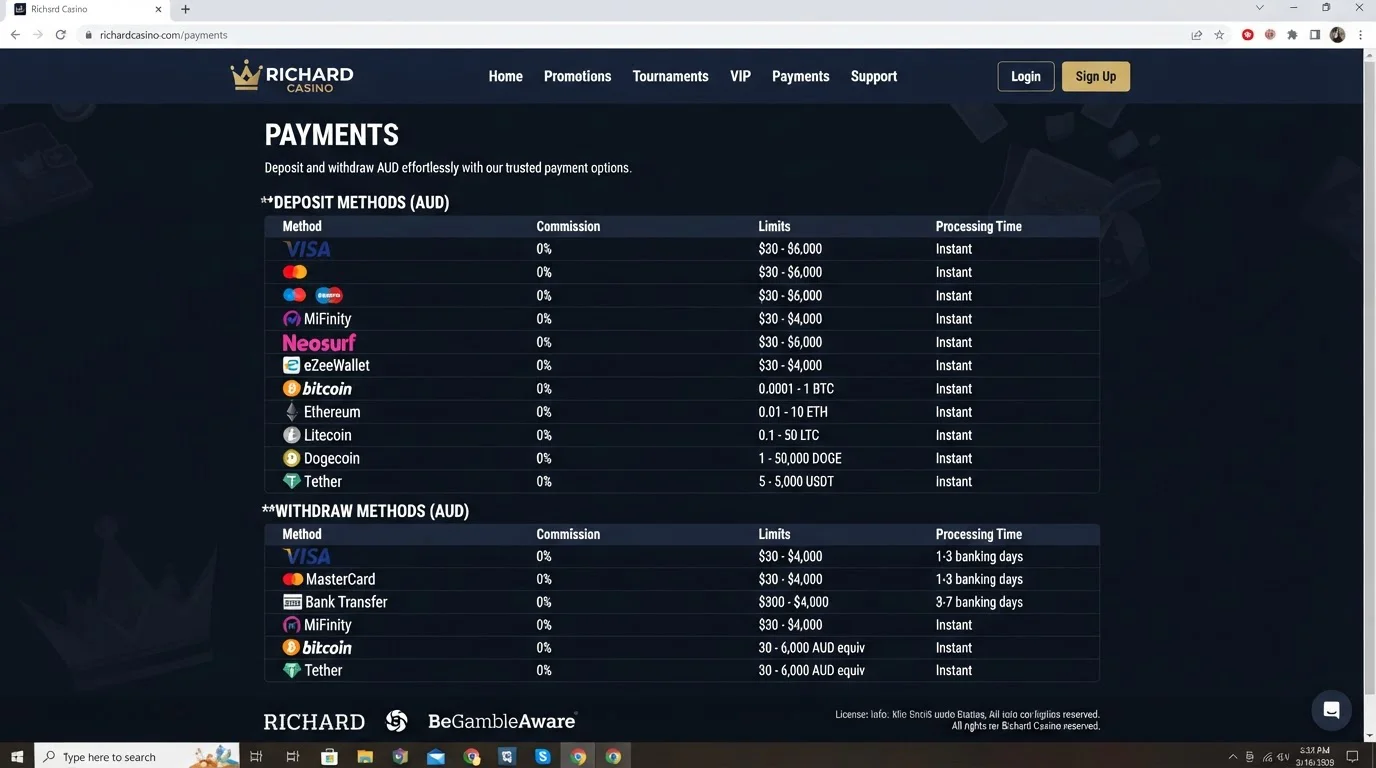
A payment option shown at the deposit stage is not automatically an option for cashing out. That distinction is easy to miss when a method looks simple: you choose it, enter the details and fund an account. Later, the withdrawal page may offer a different set of routes.
Prepaid vouchers are a clear example. A specialist review reports that vouchers such as Neosurf are generally offered for deposits, not withdrawals. Treat that as a prompt to check the specific payment terms, not as a guarantee about every service. The voucher can help put funds in, but it may not provide a route for winnings to come back out.
That’s the catch. I’d check the withdrawal methods before treating any deposit option as useful for the whole transaction. Look for a separate cashout list in the payment terms or cashier information. If it names PayID as an available withdrawal method, check what details the process asks for and whether the method is available for your account. Don’t assume a voucher balance can be converted into a PayID payment just because both appear in the same cashier.
For someone focused on an instant PayID withdrawal, the key point is that PayID has to be a supported cashout route—not merely a payment logo beside the deposit button. A deposit method and a withdrawal method serve different jobs. Read the labels carefully; “deposit” does not mean “withdrawal”.
If the listed withdrawal route is unclear, ask the operator before sending funds. Keep the response and the relevant terms, and avoid relying on a broad “fast payments” claim to answer a specific question about cashouts. The practical detail you need is whether the method can receive a withdrawal, and under what conditions. No guesswork.
There is also an important Australian context: the Interactive Gambling Act 2001 prohibits operators from providing real-money online casino games, including pokies, to people physically in Australia. So this is not a recommendation to deposit with an online casino. Understanding how payment labels differ can still help you recognise what a cashier is—and is not—promising.
The short version: a prepaid voucher may be presented as a way to fund play without being a way to receive money back. PayID may be listed separately, but you need to confirm that it is actually available for withdrawals. Check the cashout terms first, not after you have chosen a deposit method.
Look for clearly published withdrawal limits and terms, check how long operator reviews take, and complete identity verification early. PayID may transfer funds in real time after release, but remember that real-money online casino games are prohibited for operators to provide to people physically in Australia.
PayID transfers can arrive in real time after the operator releases them, but approval and checks can take longer. Reported PayID payouts range from under five minutes to as long as 24 hours in some cases; standard bank transfers can take several business days.
They are sites whose withdrawal process is relatively straightforward, with clear limits and terms and payment methods that can deliver funds quickly. PayID can provide real-time transfers after the operator approves and releases a withdrawal.
Available methods can include credit and debit cards, PayPal and Skrill, bank transfers, and, at some sites, cryptocurrency. PayID and instant banking services such as POLi are also offered by some operators; prepaid vouchers such as Neosurf are generally for deposits, not withdrawals.
Created by the ”Richard Casino” editorial team.