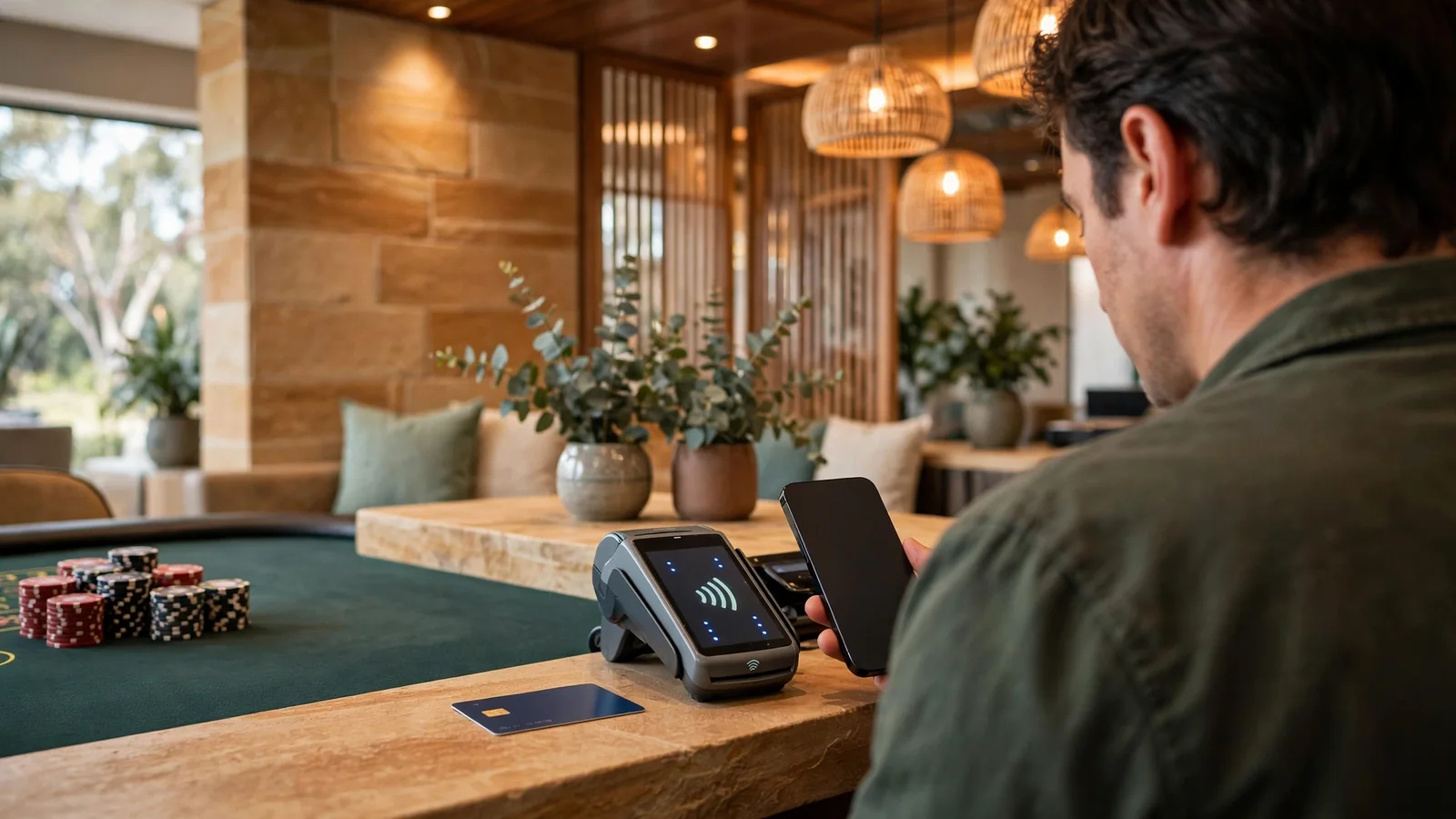
A BTC payment option shows how a casino handles deposits, not whether it is authorised to offer online casino games in Australia.

A Bitcoin option can make an offshore casino look as though it has a straightforward route into Australia: the site is online, the payment method is familiar to crypto users, and the games may load on a phone or computer. But those details describe access and payment, not permission to offer casino gambling here. I had to separate those ideas the hard way. A deposit button is not a licence.
Australia does not issue a domestic licence for online casino games. Crypto casinos therefore do not hold an Australian casino licence; they operate outside the country’s regulatory framework. An operator may hold a licence somewhere else, but that is a matter of regulation in that jurisdiction. It does not turn the operator into an Australian-licensed casino or amount to approval from Australian authorities.
Bitcoin does not change that distinction. A casino can support BTC as a payment method without having Australian regulatory approval, just as a site’s ability to accept Australian visitors does not establish that it is authorised to provide its service here. The currency is part of the transaction. It does not decide whether the underlying gambling offer is permitted.
When choosing a Bitcoin casino for Australia, check the available licensing and payment details before deciding where to play. This list highlights the information provided for each operator.
LuckyVibe
LuckyVibe is listed with a Curacao Gaming Control Board licence, number OGL/2023/176/0095, held by Hollycorn N.V.
Vegaz Casino
Vegaz Casino lists a Curacao licence, number OGL/2024/1335/0780. Its minimum deposit is EUR 20.
LevelUp Casino
LevelUp Casino lists a Curacao eGaming licence, number OGL/2023/174/0082, held by Dama N.V. The minimum deposit is A$15.
SkyCrown
SkyCrown lists a Tobique Gaming Commission licence. Its stated payout times are around 10–15 minutes for crypto and 1–5 days for fiat; the minimum deposit is A$30.
SpinsUp
SpinsUp lists a Curacao Gaming Control Board licence, number OGL/2023/174/0082, held by Dama N.V.
JustCasino
JustCasino is listed with a Curacao Gaming Control Board licence.
Uptown Pokies
Uptown Pokies is listed as licensed in Curacao and operating since 2017. Its minimum deposit is A$20.
Roby Casino
Roby Casino lists a Curacao eGaming licence held by Roby Games Ltd.
Ricky Casino
Ricky Casino states that crypto payouts take under an hour and PayID payouts take 1–3 business days. The minimum deposit is A$20, or A$30 to qualify for the bonus.
MrPacho
MrPacho states payout times of 30–120 minutes for crypto and 24–72 hours for fiat. Its minimum deposit is A$30.
That matters because “casino online Bitcoin” can describe two separate things. One is a technical arrangement: the site accepts Bitcoin. The other is a legal question: whether the operator may offer online casino games to people in Australia. The first can be true while the second remains unresolved—or, under Australian law, prohibited for the operator. Different questions. Easy to muddle.
The Interactive Gambling Act 2001 is directed primarily at operators. It makes it illegal for them to provide certain online casino services to Australian residents, and it does not need to mention Bitcoin specifically for that framework to apply. Paying with BTC does not create a separate category of casino that sits outside the rules. Changing the payment rail does not change what is being offered.
That is why a “Bitcoin casino in Australia” can be a misleading phrase. It might mean a site that an Australian user can reach and that lists Bitcoin among its payment options. It should not be read as meaning the casino is established, licensed or approved in Australia. Likewise, a foreign licence is not an Australian licence. The label alone tells you little about the site’s status here.
There is an important distinction for players too. The Australian prohibition is aimed at the entity offering the online casino service, rather than making an individual player’s act of visiting an offshore casino the same offence. That does not make the service legal in Australia, and it is not a recommendation to use one. Operator liability and player liability are different parts of the picture.
I used to treat a working site as a kind of quiet endorsement: if it opened, accepted a payment method and showed games, surely someone had checked it. That was a bad shortcut. A website being reachable is not proof that Australian regulators have approved it. Nor does a Bitcoin logo, a smooth mobile layout or a page describing an offshore licence supply that proof.
The same goes for a mobile Bitcoin casino or a live Bitcoin casino. The device and the payment method do not answer the regulatory question. A game loading on a phone is still an online service; Bitcoin remains a payment option. The relevant issue is not whether the screen works, but whether the operator is allowed to provide that casino service to customers in Australia.
So, when you see “Bitcoin casino online,” read it as a description of how the site says it handles payments—not as a statement about its Australian status. An offshore operator may be set up to accept BTC while remaining outside Australia’s licensing framework. That gap between payment access and regulatory approval is the part promotional wording tends to blur.
I would keep the terms separate in my head: Bitcoin support tells you something about the payment method; an offshore licence tells you something about the operator’s position in another jurisdiction; neither is evidence of an Australian casino licence. Australia does not issue one for online casino games. A site can look local enough without being locally authorised. That is the setup, stripped of the sales gloss.
A polished page can make a Bitcoin casino site look settled and trustworthy. I’ve learned to treat that polish as decoration. The useful comparison starts with what the operator can actually document: its licensing, the payment conditions, and the rules for getting a withdrawal approved.
First, separate an offshore licence from Australian approval. Crypto casinos are not licensed in Australia, so they sit outside the country’s regulatory framework. An overseas licence may tell you which authority the operator says supervises it, but it does not make the service Australian-licensed or remove the restrictions on operators offering online casino games to people here. Australian law targets the provider, not the player. Don’t read a badge or a claim of “licensed” as a sign that the casino has local approval.
Check the licence claim at its source rather than relying on a logo. Does the operator identify the licensing authority and the legal entity behind the site? Do the site’s terms name the same entity? If those details are vague, inconsistent or difficult to find, that is a reason to stop and reassess—not a puzzle you need to solve on the operator’s behalf. The ACMA blocks unlicensed offshore gambling sites, so access to a page is not proof that the service is authorised in Australia.
Next, compare payment support in the terms, not just on a row of coin symbols. Confirm that Bitcoin is supported for both deposits and withdrawals. A deposit option alone does not tell you whether Bitcoin can be used to cash out, or whether the operator applies separate conditions. Read the payment rules before sending anything. I would not treat a “fast” or “instant” label as a promise about when funds will be available.
Withdrawal wording deserves particular attention. Look for the steps the operator says it takes before sending a payout, whether it can request identity documents, and whether any account or bonus conditions affect withdrawal eligibility. Players must provide identity verification documents before withdrawals can be processed. If you cannot find a clear explanation of the review process, assume the headline payout claim tells you very little.
One specialist review reported casino-side processing adding 12–48 hours before a Bitcoin payout was sent. That is a report from a review, not a dependable timetable for every operator. The key comparison is whether the site explains its own approval process and what could hold a request up. A blockchain transfer and an operator’s decision to release it are separate things.
Promotions are another place where the big label can hide the useful detail. “Best bonus” is just a sales phrase until you have read the conditions attached to it. Before treating an offer as part of a comparison, check its wagering requirement, eligible games, maximum cashout and any payment methods excluded from the promotion. A bonus that conflicts with the way you intend to deposit or withdraw may be no benefit at all. I’d compare the terms, not the headline figure.
The same goes for claims about the games or the newest features. A broad catalogue or a “latest” label does not establish that a site is reliable, and it does not change the legal position. Look for precise terms and consistent information rather than promotional adjectives. If the site makes a claim you cannot verify in its own rules, don’t build a money decision around it.
I wouldn’t make a ranked list from marketing claims. Compare the documents, the payment conditions and the withdrawal process, then decide whether the uncertainty is acceptable to you. If essential terms are missing, that is the clearest signal available. Stop there.
A live table can look like a casino floor brought to your screen: a dealer, cards or a roulette wheel, and bets placed through an account. Add a Bitcoin payment option and the site may seem like a straightforward fit. I’ve learned not to let the cashier decide the legal question. The payment method and the game service are separate things.
In Australia, the Interactive Gambling Act 2001 is aimed primarily at the operator. It prohibits providing online casino-style games to people here, including live versions of blackjack and roulette. Whether the account is funded with Bitcoin, another cryptocurrency or a different method does not alter what the operator is offering. A digital coin is not a legal workaround.
That distinction matters when an offshore site describes itself as a “Bitcoin live casino.” The label tells you something about how it may handle payments; it does not establish that the operator is authorised to provide live casino games to Australians. Nor does a dealer appearing on screen change the service into something outside the online gambling rules. The relevant point is that casino-style play is being supplied online to a person in Australia.
I used to treat payment options as a kind of reassurance. If a site took a familiar coin and the pages looked polished, I assumed someone had checked the rest. That was a bad shortcut. A Bitcoin button says nothing by itself about the site’s legal position, and a live dealer does not make that position better.
There is a narrower point about the player. The Act’s prohibition is directed at the business providing the service, rather than making it an offence for an Australian to play at an offshore-licensed casino. That does not turn the service into an Australian-approved casino, and it does not mean every site claiming an offshore licence has been verified. Those are different questions. Keep them separate.
A search for the best live casino accepting Bitcoin can blur those questions together. “Best” might refer to a payment feature, a dealer interface or a bonus, but none answers whether the operator may offer the game to someone in Australia. The same applies when a site promotes itself as an online casino accepting Bitcoin, or advertises a no-deposit bonus. A promotional offer and a crypto cashier do not change the legal character of live casino play.
I would read the site’s claims with that in mind, rather than treating “offshore licensed” as shorthand for “approved here.” An offshore licence is not an Australian licence. The Act does not create a route for an operator to offer online casino games under a local Australian casino licence; the central issue is the restriction on supplying those games to Australian residents.
The uncomfortable part is that the site can still be accessible and still present a convincing live table. Access is not proof of permission. A payment can go through without confirming that the underlying service is lawful for the operator to provide in Australia. Don’t mix up those signals.
So if you are considering a live dealer table funded with BTC, judge the claim in the right order: first recognise what game is being offered and who is offering it, then treat Bitcoin as a payment detail—not a legal stamp. The interface may look ordinary. The distinction is not.
A headline promising a “best Bitcoin slots bonus” is not a reason to deposit. It is an invitation to inspect the conditions attached to the offer. I have learned to treat words such as “free” and “no deposit” as labels, not as a description of what I can actually keep. A bonus may come with restrictions that matter more than the advertised amount.
Before considering any promotion, find its full terms and check four things: wagering requirements, eligible games, maximum cashout and payment-method exclusions. If the terms are hard to locate or unclear, that is useful information in itself. Don’t assume that a bonus applies just because a page mentions Bitcoin or online pokies.
Wagering requirements describe how much qualifying play is required before bonus funds or related winnings can be withdrawn. The wording matters: the requirement may apply to the bonus, the deposit and bonus together, or winnings, depending on the offer. Read the definition rather than relying on a short banner. If you cannot tell what must be wagered and when the condition is complete, you cannot sensibly judge the offer.
A bitcoin casino deposit bonus may sound straightforward, but the deposit method can affect eligibility. Some promotions exclude cryptocurrency deposits, while others may apply different terms to them. Check the payment section of the offer before sending funds; don’t infer eligibility from a Bitcoin logo or a general claim that a site accepts crypto.
A slots-related promotion may restrict which games count toward its requirements. The terms should identify eligible games or explain how excluded games are treated. If you plan to play video slots, confirm that the specific category qualifies rather than assuming every game contributes in the same way. A restriction can make an otherwise appealing offer much less useful.
Then look for a maximum cashout. This sets a ceiling on what can be withdrawn under the promotion, even if the balance shown on screen is higher. Check whether that ceiling applies to bonus winnings, winnings from a no-deposit offer, or another defined part of the balance. The label “no-deposit Bitcoin bonus” does not tell you what you may withdraw.
“Free Bitcoin slots” can also mean different things on a site: a promotional offer, or games that can be tried without real-money stakes. Neither phrase proves that a cash bonus is available, or that winnings from a promotion are withdrawable without conditions. Read the relevant terms, not just the tile or headline.
There is another catch that no bonus page can fix. Under Australia’s Interactive Gambling Act 2001, operators are prohibited from providing real-money online casino-style games, including slots, to people in Australia. A foreign licence does not amount to Australian approval, and a Bitcoin payment option does not change the legal position. These promotions should not be read as evidence that a casino is authorised to offer online pokies to Australians.
My rule is simple: judge the written conditions, not the sales language. If wagering, game eligibility, cashout limits or payment exclusions are vague, skip the offer rather than guessing. A bonus is only as clear as its terms. No magic wording.
“Accepts Bitcoin” sounds like a simple payment label. In practice, it needs to mean more than a Bitcoin logo beside a cashier button. The casino has to support BTC for the action you want to take: depositing, withdrawing, or both. A site that lets you pay in Bitcoin but won’t send a payout to your Bitcoin wallet has only half-supported the payment method.
A specialist review describes the basic arrangement this way: you send cryptocurrency from your own wallet to an address provided for the casino deposit, then request a withdrawal to a wallet address you supply. The address and the coin matter. Before sending anything, confirm that the cashier specifies Bitcoin and that the withdrawal page also lists Bitcoin as an option. Don’t assume that support for one crypto coin means support for another.
The payment is not a bank transfer with a person checking the details for you. You copy the designated address into your wallet, enter the amount, and confirm the transaction there. Take the extra moment to compare the address on screen with the one in your wallet before sending. Crypto transfers can’t simply be reversed if you send funds to the wrong address or choose an unsupported network. A small typo can become a permanent loss.
That’s what I look for in a “Bitcoin casino”: not the badge, but whether the cashier clearly explains the deposit and withdrawal routes. Check the exact coin and network shown for each. If the casino lists BTC for deposits but gives no clear Bitcoin withdrawal option, don’t treat that as full Bitcoin support. The same goes for vague wording that leaves you guessing which wallet address to use.
There’s another part the payment label can’t tell you. Crypto casinos aren’t licensed in Australia, so they sit outside the country’s regulatory framework. A Bitcoin option does not make a casino Australian-licensed or mean the service is approved to offer online casino games to people here. The Interactive Gambling Act 2001 prohibits operators from providing real-money online casino games to Australian residents. Payment access and legal approval are separate things.
Bitcoin’s value can also change while funds are held or between a deposit and a later sale. That can affect what your BTC is worth in Australian dollars, even if the number of coins in your wallet is unchanged. The payment method does not remove that price risk.
So when a site claims it takes BTC, read the claim narrowly: it may accept Bitcoin for a particular transaction under the conditions shown in its cashier. Confirm that both deposits and withdrawals are supported before sending anything, and check every address and network carefully. The label is not the whole deal.
Before considering any real-money casino activity, be clear about the Australian position: an offshore licence is not Australian approval. The Interactive Gambling Act prohibits operators from offering online casino games to people in Australia. Players are not generally liable simply for accessing an offshore site, but that does not make the service lawful here or give you local consumer protections.
If you are checking how a site handles Bitcoin, start with the wallet rules, not the games page. Confirm that it accepts Bitcoin for withdrawals as well as deposits. A deposit option alone does not tell you whether you can receive a payout in the same coin. Check which network the site requires, then make sure your wallet is set to that exact network. Sending to the wrong address or over the wrong network can mean a permanent loss.
I would also avoid keeping funds on a gambling account longer than necessary. The wallet address for a withdrawal must be one you control and can access. Check every character of a deposit address before sending; crypto transfers cannot be reversed just because you spot a mistake afterward. “Instant play” sounds like a shortcut, but it only describes when a site may let you begin after detecting a transaction. It does not remove the need to verify the payment and withdrawal rules.
Expect identity checks before a payout. A casino may ask for documents to verify who you are, so read its requirements before depositing and use accurate account details. If you cannot or will not provide the requested documents, a withdrawal may not be processed. That is an awkward point to discover after a win.
Do not use a VPN to get around a site’s location restrictions. It can breach the operator’s terms and put your account or winnings at risk. If access is blocked, treat that as a restriction—not a technical puzzle to solve.
Self-exclusion needs a separate check, too. If you are registered with BetStop or a state-based self-exclusion program, you must also self-exclude directly with each offshore platform. Do not assume an Australian exclusion automatically carries over. If you have chosen to stop, that extra step matters.
Finally, remember that Bitcoin’s value can change between buying it, depositing it and receiving a payout. A balance displayed in BTC is not a fixed Australian-dollar amount. Keep the decision separate from the sales pitch. Verify first.
I used to think a Bitcoin casino was mainly a payment-method question: if the site took BTC, the games were just another option on the menu. That misses the part that matters in Australia. The law looks at what the operator provides, not at whether the player pays with Bitcoin, a bank card or something else.
The Interactive Gambling Act 2001 prohibits operators from providing online casino-style games to people in Australia. That category includes slots, poker, blackjack and roulette. Calling them Bitcoin games, hosting them offshore or putting a crypto wallet between you and the cashier does not change the game’s legal classification.
So the distinction is not “Bitcoin games versus ordinary casino games”. It is whether an operator is offering a prohibited online casino service to Australian residents. A Bitcoin casino payment may describe how a site handles funds; it does not establish that the site is authorised to offer casino play here. The coin changes the payment rail, not the rule.
That is the catch behind searches for Bitcoin casino games or a Bitcoin slot game. The labels can make a site sound like a separate category, but the underlying activity is still online casino-style gambling. I would not treat a crypto option as evidence of local approval. It is not a licence.
ACMA’s role includes restricting access to unlicensed offshore gambling services. It has taken action against multiple operators and blocked their sites, so a page that once opened may later be inaccessible from Australia. A block is an enforcement measure aimed at the service; it does not turn the operator’s offer into a lawful one or make Bitcoin a workaround.
There is a practical reason not to read too much into a site’s availability, either. A functioning website, a BTC cashier and a list of games can all appear together without showing that the operator has Australian approval. They tell you what the business displays, not whether it may legally provide those games to people here.
If you are checking a casino game that accepts Bitcoin, separate the payment question from the legal one. The Act is concerned with the operator offering the game to Australians, and ACMA can act against unlicensed offshore sites. That applies across the named casino-style games, not only to pokies or table games. Bitcoin does not redraw the boundary.
Bitcoin changes the payment rail, not the basic risk. In a casino payment flow, funds move from a personal crypto wallet to an address provided by the operator. A specialist review describes these payments as being recorded on the blockchain, where transaction details can be checked. That record can help establish that a transfer was made; it does not prove the operator is trustworthy, settle a dispute, or give you the same recourse as a reversible card payment.
That distinction matters. A blockchain entry is visible, but the transaction itself cannot simply be cancelled after it has been sent. If you send BTC to the wrong address, select the wrong network, or make another transfer error, the funds may be permanently lost. I once treated a copied address like a harmless form field. It isn’t. Check the destination and the casino’s network instructions carefully before authorising anything.
There is another catch: Bitcoin’s value can move while funds are held. The amount displayed in BTC may stay the same even as its value in Australian dollars changes. A deposit can therefore be worth less in fiat terms by the time you use it; winnings can also lose value before you convert or spend them. “Fast” does not mean price-stable.
The same issue can follow you after gambling. The ATO treats cryptocurrency as an asset for capital gains tax purposes. Recreational gambling winnings are generally treated as windfalls rather than taxable income, but that does not make every later crypto gain tax-free. If you acquired BTC, used it, received it back, and later sold it at a profit, the change in its value may have CGT consequences. Keep records of relevant transactions and get tax advice if you are unsure how your circumstances apply.
None of this makes a bitcoin casino lawful to offer in Australia. The Interactive Gambling Act targets operators offering online casino-style games to people here; a crypto payment option does not change that position or provide Australian regulatory approval. Payment access and legal status are separate questions.
So, when weighing an Australian bitcoin casino, don’t treat “blockchain” as a safety badge. It can make transfers traceable, while leaving them irreversible and exposed to price swings. The technology records movement. It does not protect your balance.
A Bitcoin deposit does not appear in a casino balance the moment it leaves your wallet. The transaction first has to be recorded on the blockchain, and the casino may wait for confirmations before crediting it. Until that happens, the payment can show as pending even when the address and amount were entered correctly.
A specialist review describes a single Bitcoin confirmation as taking 10–60 minutes, depending on network congestion and the fee attached to the transaction. That is a reported range, not a clock you can rely on: congestion changes, and the casino’s own crediting threshold matters too. Specialist reviews report that casinos may require 1–3 confirmations before adding a deposit to an account. Check the payment instructions on the site you are using rather than assuming its threshold matches another casino’s.
The fee can affect how quickly a transaction is picked up. When the Bitcoin network is busy, fees may rise; choosing a fee that is too low can leave the transfer waiting longer. The casino cannot credit a deposit it has not yet recognised as sufficiently confirmed. Don’t send a second payment just because the balance has not updated—first check the transaction status and the casino’s stated confirmation requirement.
I’ve learned not to treat a pending label as proof that funds have vanished. But I also would not send money to an offshore casino simply because it accepts Bitcoin. Australian law prohibits operators from providing real-money online casino games to people in Australia; a payment option does not change that or amount to Australian approval. Any decision to use an offshore service carries that distinction with it.
If a transaction remains uncredited, compare its status on the blockchain with the casino’s deposit instructions, then contact the operator with the transaction details. Before sending anything, verify the address and the required Bitcoin network carefully. Blockchain payments are irreversible: a wrong address or network can mean a permanent loss. No easy undo.
Bitcoin does not change what a slot game is under Australian law. The Interactive Gambling Act 2001 prohibits operators from providing online casino-style games, including slots, to people in Australia. Paying with BTC instead of a card does not turn the game into a different category or make an offer lawful.
That is the part easy to miss when a page presents Bitcoin pokies as just another way to play. The payment method may be cryptocurrency; the game is still an online slot. The law is aimed at the operator offering the service, not at the Bitcoin label attached to its cashier or games page.
I’ve learned not to treat a polished site or a confident “licensed” badge as proof that a service is approved to offer casino games in Australia. Australia does not issue a domestic licence for online casino games, and an offshore licence does not amount to Australian approval. A site’s willingness to accept Australian users is not the same thing as permission to offer them slots.
So if you come across bitcoin casino slots advertised for Australian players, read the claim for what it is: a sales pitch, not a legal green light. The same applies to BTC slots described as exclusive, instant or available to Australians. Those phrases do not change the law. Short version: Bitcoin is not a loophole.
The distinction matters because the Interactive Gambling Act places the prohibition on the provider. It is not a statement that an Australian player is committing an offence simply by seeing a site or using cryptocurrency. But access, payment support and legal approval are separate things. One does not establish the others.
I would keep that separation in mind before treating any “licensed Bitcoin casino” claim as reassurance. The key question is not whether a site accepts Bitcoin or has slot games on screen; it is whether the operator may legally offer those games to people located in Australia. For online slots, the Act’s restriction is clear.
Australian players are not specifically prohibited from using Bitcoin at offshore casinos. The Interactive Gambling Act 2001 targets operators offering online casino games to Australian residents, and using BTC does not make that service Australian-approved.
Crypto casinos do not have Australian licences, and the Interactive Gambling Act 2001 prohibits operators from offering certain online casino games to Australian residents. The law targets the operator, rather than making an individual player’s act of visiting an offshore casino the same offence.
Yes, if the casino supports Bitcoin withdrawals, you can request payment to your wallet. Casino processing may add 12–48 hours; after it is sent, a payout typically reaches a personal wallet within an hour, depending on blockchain confirmations and network conditions.
Bitcoin payments go directly from your wallet, and transactions are recorded on the blockchain for verification and transparency. A casino may also let you begin playing once it detects a deposit, before the transaction is fully confirmed.
Check the operator’s claimed licence, the licensing authority and legal entity, and whether those details match the site’s terms. Also confirm in the terms that Bitcoin is supported for both deposits and withdrawals; a deposit option alone does not confirm withdrawal support.
The Interactive Gambling Act 2001 governs the provision of certain online gambling services, including online casino games, to Australian residents. It targets operators and does not specifically mention Bitcoin or cryptocurrency.
Created by the ”Richard Casino” editorial team.