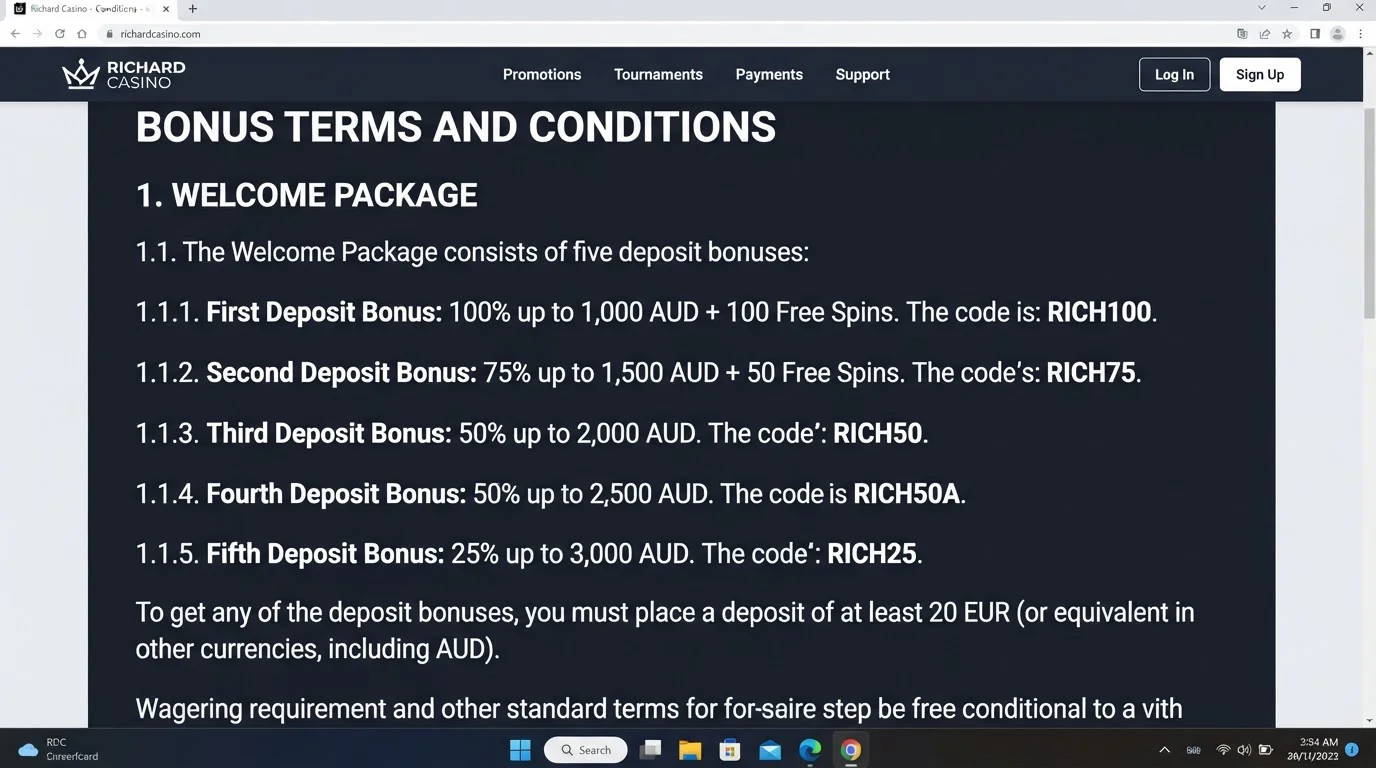
No-wagering terms remove a playthrough hurdle, but bonus funds remain distinct from winnings and withdrawals still depend on other rules.

“No wagering” sounds like a promise that whatever appears on your screen can be cashed out. I used to read it that way. The important distinction is between the bonus funds and anything you win by using them: the bonus itself is not withdrawable, while winnings generated from it may be eligible for withdrawal without a playthrough requirement.
That is a narrower promise than it first appears. If an offer credits bonus funds to your account, those funds are there to be used under the offer’s rules. They are not cash you can simply request as a payout. A win made with them is a separate amount, and that is the part that may qualify for withdrawal. No wagering removes one possible hurdle; it does not turn the original bonus into cash.
Even then, “eligible” does not mean “already paid”. Winnings may be available to request after you have used the bonus, but other terms can still affect whether the request is accepted and how much can be paid. You need to complete KYC verification before any withdrawal, including checks of your identity, address and payment method. If those checks are incomplete, a payout request can be delayed even when the offer has no wagering requirement.
If you’re looking for a no-wagering casino bonus in Australia in 2026, check the terms carefully before choosing where to play. This list gives you a concise reference to the available operator details.
LuckyVibe
LuckyVibe is listed with a Curacao Gaming Control Board licence, OGL/2023/176/0095, held by Hollycorn N.V.
Vegaz Casino
Vegaz Casino lists a Curacao licence, OGL/2024/1335/0780, and a minimum deposit of EUR 20.
LevelUp Casino
LevelUp Casino lists a Curacao eGaming licence, OGL/2023/174/0082, held by Dama N.V. Its minimum deposit is A$15.
SkyCrown
SkyCrown lists a Tobique Gaming Commission licence and a minimum deposit of A$30. Its stated payout times are around 10–15 minutes for crypto and 1–5 days for fiat.
SpinsUp
SpinsUp lists a Curacao Gaming Control Board licence, OGL/2023/174/0082, held by Dama N.V.
JustCasino
JustCasino is listed with a Curacao Gaming Control Board licence.
Uptown Pokies
Uptown Pokies is listed as operating under a Curacao licence since 2017, with a minimum deposit of A$20.
Roby Casino
Roby Casino lists a Curacao eGaming licence held by Roby Games Ltd.
Ricky Casino
Ricky Casino lists a minimum deposit of A$20, or A$30 to qualify for the bonus. Its stated payout times are under an hour for crypto and 1–3 business days for PayID.
MrPacho
MrPacho lists a minimum deposit of A$30. Its stated payout times are 30–120 minutes for crypto and 24–72 hours for fiat.
There is also a difference between a balance being shown on screen and it being withdrawable. Read the offer’s wording to see whether winnings are added to a cash balance that can be requested, or held in a bonus balance until the stated conditions are met. The phrase “no wagering” alone does not tell you how the operator records the money. I would not treat a number in the account as cash in hand until the terms explain its status.
The other phrase to look for is “max cashout cap”. This sets a ceiling on the amount that can be withdrawn from the promotion. A win can be eligible in principle and still be reduced if it goes beyond that ceiling. In other words, the absence of a wagering requirement does not mean there is no limit on the payout.
The figures reported for these caps do not agree. One account of Australian no-wagering offers puts the limit at five to ten times the bonus amount. Another gives separate cash ranges: A$20–A$100 for no-wagering free spins and A$50–A$500 for deposit bonuses. Those are conflicting descriptions, not one reliable universal scale. The only safe reading is the cap written in the specific offer’s terms; do not infer it from the words “no wagering” or from another promotion.
This matters most when the headline makes the bonus sound larger or freer than it is. Imagine a promotion displaying bonus funds and then showing a win. You may be able to request that win without completing wagering, but you cannot request the original bonus funds, and a cashout cap may limit the eligible winnings. KYC and any other applicable offer conditions still sit between the balance and a completed withdrawal. No magic wording removes those steps.
I have found it useful to read the payout language before paying attention to the advertised amount. Look for a clear statement of what counts as winnings, whether those winnings become withdrawable cash or remain in a bonus balance, and whether a max cashout cap applies. If the terms use “no wagering” prominently but do not make the payout rules clear, the headline is not enough to judge what can actually be withdrawn.
So the practical meaning is simple, even if the small print is not: the bonus is not the payout. Winnings made with bonus funds may be withdrawable immediately after the bonus has been used, but only subject to the offer’s other conditions, KYC verification and any cap. “No wagering” removes a playthrough hurdle. It does not guarantee an unrestricted cashout.
The phrase “no wagering” sounds like the whole balance is ready to cash out. It isn’t. The label refers to whether winnings have to be played through again, not whether every credit shown on screen belongs to you as withdrawable money. I’ve learned to follow the balance from the moment an offer is activated, rather than trusting the headline.
The usual sequence is straightforward in outline. An offer is attached to an account, its funds become available for eligible play, and any resulting winnings are assessed under the offer’s terms. If those terms genuinely waive wagering, the winnings do not have an extra playthrough requirement before withdrawal. That still leaves the original bonus funds out of reach: you cannot withdraw those funds themselves. Only winnings produced by using them can qualify.
That difference can be hard to see in an account screen. A displayed total might combine cash, promotional credit and winnings, even though those amounts have different status. Think of the bonus as a temporary source of play, not a cash deposit. The winnings are a separate result. A balance that looks like one pot may not behave like one.
Before an offer is activated, its terms should say what counts as eligible play and whether the bonus is tied to particular games or providers. Do not assume that every game on a site qualifies. If a game is excluded, using it while the promotion is active may put the bonus or its winnings at risk. A specialist review has reported that ineligible play can void an offer; the operator’s own terms are the practical rules to check before anything is used.
Once the bonus is active, the account may show promotional funds separately or combine them with another balance. The label alone does not settle what can be withdrawn. Look for wording that explains when winnings move into a withdrawable cash balance and whether they remain in a locked bonus balance first. The treatment can depend on the offer’s terms and the site’s accounting. If that point is unclear, do not treat the displayed total as cash you can take out.
I made the mistake of focusing on the word “cash” and skipping the balance rules. The useful question is not simply whether a win appears in your account. It is whether the terms classify it as withdrawable, whether any conditions remain, and whether the bonus funds are still being kept separate.
A no-wagering condition removes one hurdle; it does not remove the withdrawal process. KYC verification is required before any withdrawal. That means the account holder may need to verify identity, address and the payment method, and the information should match the account details. Until those checks are completed, eligible winnings may not be paid out.
The withdrawal request can also be affected by other offer terms, including a max cashout cap, a time limit, game restrictions or exclusions linked to the withdrawal method. Those are separate from wagering. A promotion can have no playthrough requirement and still limit how much of the winnings is payable or set conditions for requesting the money. Check for those terms before activating anything, not after a win has appeared.
Keep the relevant terms and any account messages. If the balance changes after play, or a withdrawal is refused, you will want to compare the explanation with the rules that applied when the offer was activated. A marketing label is not a substitute for the detailed terms.
There is an important distinction between explaining an offer and recommending that you use one. Under the Interactive Gambling Act 2001, operators are prohibited from providing real-money online casino games to people physically in Australia. An offshore site may still display a promotion to Australians, but that does not make the service locally authorised or give you ordinary local regulatory recourse if a dispute arises. The law is directed at operators; this explanation is not an invitation to play.
So, when you see an online casino bonus described as having no wagering, read it as a claim about one part of the terms—not as a promise of unrestricted access to the displayed balance. The bonus itself is not withdrawable; only qualifying winnings may be. Those winnings still have to pass the offer rules and KYC checks before a withdrawal can be processed.
That is the mechanics. The fine print decides.
“No deposit” describes what you need to pay to claim an offer. It does not tell you whether you can withdraw anything straight away. I used to see “free” and mentally skip to the cashout button. That was optimistic.
With a no-deposit bonus, you may have to use the promotional funds before any winnings become eligible for withdrawal. A free-spin offer works along the same basic lines: the spins must be played, and the offer’s terms determine what happens to any return. The important distinction is between receiving an offer and satisfying the conditions attached to it. One does not automatically mean the other.
Read the withdrawal wording, not just the headline. It should say whether winnings from the offer are credited to your real cash balance or kept in a locked bonus balance until a stated condition is met. If the winnings are credited as cash under a no-wagering offer, they may be available to withdraw once you have met the other terms. If they remain locked, check what action releases them. And if the terms require you to wager winnings before withdrawal, that is a wagering requirement, whatever the headline calls the promotion.
“Free” has conditions.
Registration can be part of the claim. A report by thegamehaus.com describes no-deposit offers involving free spins that require an account and identity checks. The practical point is simple: an offer may not be available anonymously, and creating an account does not settle whether you can cash out. The account details and the offer’s eligibility rules still matter.
Before withdrawing, expect KYC verification. That means the operator may ask you to confirm your identity, address and payment method. I would rather discover that before trying to withdraw than after a win is sitting in an account. Use accurate details when registering and check that you can complete the requested checks. If you cannot, the apparent value of the offer is beside the point.
There is another trap in the phrase “no wagering.” It can describe one part of an offer without removing every other condition. A bonus may have no playthrough requirement yet still require you to activate it, use the promotional funds or spins, and complete KYC before a withdrawal request can proceed. It may also carry a cashout cap, an expiry date, game restrictions or limits on withdrawal methods. Those conditions can affect whether you receive the full amount shown as winnings.
For free spins, check where the resulting winnings are placed. If the terms say they are credited as cash, they go to the cash balance; if they are held in a bonus balance, look for the condition that unlocks them. Don’t assume that every offer handles this the same way. A balance label can be more informative than the promotional banner.
I also wouldn’t treat “no deposit” as a reason to rush through the terms. Find the eligibility rules, the point at which the offer expires, any limit on payable winnings, and the withdrawal conditions. If you cannot find a clear explanation of how the winnings move from the offer to an available balance, there is no need to guess. A free claim can still leave you with nothing withdrawable.
For Australian readers, there is a further distinction worth keeping in view: real-money online casino services are prohibited for operators under Australian law, and offshore sites are not licensed by Australian states or territories. A promotion does not change that legal position or provide local regulatory recourse if a dispute arises. So this is not a recommendation to claim one; it is a reminder that the word “free” does not remove either the terms or the risks.
A low-wagering bonus sounds close to a no-wagering bonus, but the difference is plain: one still makes you play through a stated amount before the bonus-related balance can be withdrawn. Even a small requirement is a wagering requirement. “Low” describes its size, not its absence.
I used to read the number and think, “That’s barely anything.” That was the trap. The requirement can apply to the bonus, the deposit and bonus together, or another amount defined in the terms. Those are not interchangeable calculations. Before treating an offer as manageable, find the exact base and the point at which the requirement is considered complete.
Low-wagering offers are a common alternative to genuine zero-wagering bonuses in Australia. The label can be useful, but it does not tell you what counts toward completion or whether other conditions affect a withdrawal. A genuine no-wagering offer has no playthrough requirement on the relevant winnings; a low-wagering one does. If a promotion calls itself no-wagering but then requires even one round of playthrough, that label is misleading.
The comparison with traditional bonuses is less tidy than the marketing makes it seem. One set of published figures puts traditional Australian casino bonus requirements at 30x to 45x, while another gives a broader range of 30x to 60x. Those ranges disagree, so I would not treat either as a universal market rule. The useful distinction is that low-wagering offers are presented as a less demanding alternative, not as requirement-free cash.
A low number still needs context. Check whether all games contribute equally, whether some are excluded, and whether the offer has a deadline, a max cashout cap or withdrawal-method exclusions. Game restrictions matter: using an ineligible game while a bonus is active may void the bonus entirely. These conditions can change the practical value more than the headline wagering figure does.
I also check what happens to winnings while the requirement is incomplete. The terms should say whether they sit in a locked bonus balance or move into the cash balance, and what must happen before a withdrawal request is allowed. No-wagering language alone does not answer those questions; nor does “low wagering.” Read the specific offer, not just the badge.
Before any withdrawal, KYC verification is required, including checks of identity, address and payment method. That remains true even where a bonus has no wagering requirement. A low-wagering offer does not bypass those checks, and passing them does not remove the offer’s other conditions.
My old mistake was comparing the requirement number and stopping there. Now I treat it as one line in a longer set of terms. If the base is unclear, games are restricted, or the deadline and cashout rules are hard to find, the smaller figure does not make the offer simple. It just makes the headline look better.
A low-wagering casino bonus may therefore be a compromise for someone comparing promotion terms, but it is not the same product as a no-wagering bonus. And because real-money online casino services are prohibited for operators serving people in Australia, this comparison is informational, not a recommendation to sign up or play.
A welcome bonus sounds like a substantial first deposit boost. A genuine no-wagering version is a different proposition: it is a deposit offer whose winnings are not subject to a playthrough requirement. In practice, such offers are rare at offshore sites aimed at Australians. A banner can make the idea look ordinary; finding clear terms that actually match it is another matter.
The amounts tend to be modest. One specialist review describes no-wagering promotions as offering $5–$10 in bonus cash or 20–50 free spins. Treat that as a snapshot, not a promise of what is available now. A small headline figure is not necessarily a poor offer, but it leaves less room for ambiguity: the terms should say plainly whether the promotion is genuinely zero-wagering and what happens to any winnings.
That distinction matters. If winnings are credited as bonus cash and must be played through, the offer is not truly no-wagering, whatever the headline says. Nor does “no wagering” mean every dollar shown beside the offer can be withdrawn. The bonus funds themselves may not be cashable; the terms need to explain whether winnings go to the real-money balance or remain locked in a bonus balance.
I used to focus on the first line and skim the rest. That is how a neat little welcome offer turns into a puzzle. Check the full promotion terms before depositing: a max cashout cap, expiry date, eligible-game restriction or excluded withdrawal method can still limit what the offer is worth. Playing an ineligible game while the bonus is active may void it. The cashout rules are part of the offer, not a footnote to ignore.
KYC verification is required before a withdrawal, including checks of identity, address and payment method. A no-wagering label does not remove that step. If you are not prepared to provide the required verification, do not assume that a displayed win can be paid out.
There is also a more basic issue for anyone in Australia. Under the Interactive Gambling Act 2001, operators cannot provide real-money online casino games to people physically in the country. The law targets providers rather than making the player liable, but that does not make an offshore site locally licensed: Australian states and territories do not license these casino services, and local recourse in a dispute is limited. ACMA blocks unlicensed sites. Adults aged 18 and over are the only people who may gamble, but age does not change the restrictions on operators.
So a no-wagering casino welcome bonus is not a dependable way to turn a first deposit into withdrawable cash. If you encounter one, read the terms as a set of limits and conditions, not as a promise. Small print matters.
A no-wagering label tells you about playthrough, not which games you can use. Eligibility can be tied to a particular game, provider or offer, so the same game may qualify for one promotion and be excluded from another. I’ve learned not to assume that a game is eligible just because it appears in the site’s regular lobby. Different rules. Same lobby.
The offer terms should identify the games or providers allowed while the bonus is active. Restrictions can cover high-RTP pokies, live dealer games, table games and video poker. Some offers name a limited group of eligible games; a report from thegamehaus.com also describes promotions that permit a wider choice but apply a cap to promotional winnings. Treat that as a report about particular offers, not a rule that applies everywhere.
The practical risk is more than earning nothing from a spin or hand. A specialist review has reported that playing an excluded game while a no-wagering bonus is active can lead to the bonus being voided or winnings being affected. The operator’s terms determine what happens, which is why I’d check the exact offer before touching a game—not rely on a general “no wagering” banner.
Pay attention to when the restriction applies. The terms may cover play while bonus funds are active, and may spell out what happens to winnings from an ineligible game. If that wording is unclear, ask the operator in writing before playing. A vague answer is not a reassuring one.
Also check how winnings are recorded. The offer should make clear whether they go to your real cash balance or remain in a locked bonus balance. “Withdrawable” is not the same as “already available to withdraw.” KYC verification—identity, address and payment method checks—is required before any withdrawal, even when there is no wagering requirement.
Game eligibility is only one part of the terms. A no-wagering bonus may still have a max cashout cap, an expiry date, or withdrawal method exclusions. Those restrictions can affect what you can actually take out even if you played only eligible games. Read the offer as a whole, not just the line that says “no wagering.” That phrase is only one piece.
I used to look for a game I liked first and read the conditions later. That’s backwards: one excluded game can turn a straightforward offer into a dispute over the bonus and its winnings. Check the eligible-game list and provider rules before activating or using the promotion.
A no-wagering casino bonus does not change the legal position of the service offering it. Australia’s Interactive Gambling Act 2001 prohibits operators from providing real-money online casino games to people physically in Australia. The legal restriction is aimed at the operator, rather than making the player liable for using an offshore site. That distinction matters, but it is not an endorsement or a guarantee that an offshore offer is safe.
You may see conflicting descriptions of the law: one says Australian players can legally use offshore casinos because the Act targets operators; another says the Act prohibits online casino gambling for Australian residents. The practical distinction is that the Act prohibits the service being provided in Australia, while the stated legal framework does not impose player liability for using it. I would not read that as local approval or protection.
Offshore sites accepting Australians are not licensed by Australian states or territories. The Australian Communications and Media Authority blocks websites of unlicensed operators, so access can be disrupted. A site appearing online, or a promotion being visible, does not mean it is authorised to provide casino gambling here.
The bigger problem shows up when something goes wrong. If a withdrawal is disputed, an account is closed, or an operator stops responding, Australian players have limited legal recourse. You may not have a local regulator able to resolve the complaint or a straightforward way to enforce an overseas operator’s terms. A polished site and a “no-wagering” label do not fix that gap.
I have learned not to confuse a clear bonus offer with a dependable remedy. If the operator is offshore, the dispute may have to be pursued beyond Australia, and the practical obstacles can be substantial. Read the terms before sharing personal or payment details, and consider whether you would be comfortable with the limited options available if the account or payment becomes contested. No local safety net.
Real-money gambling is restricted to adults aged 18 and over. That age threshold does not make an offshore casino locally regulated, nor does it remove the risks of dealing with a provider outside Australia’s system. The essential point is simple: the bonus may describe what the operator promises, but it cannot create Australian oversight where none exists.
With no-wagering free spins, the clock can matter more than the spin count. The offer may expire before you get around to using it, and “no wagering” does not mean the winnings are unlimited or ready to leave without checks.
Expiry information is not consistent across published descriptions. One account puts the usual window at 24 to 72 hours after the spins are credited; another gives a broader range, from 24 hours to seven days after activation. Those are not interchangeable starting points. Check the offer itself for both the deadline and when its timer begins. A short window is easy to miss. I have.
The other catch is the cap. One set of reported terms puts the maximum payable win from a free-spin offer between A$50 and A$200; another puts free-spin cashout caps between A$100 and A$500. That disagreement is worth stating plainly: there is no single range you can safely assume applies to every offer. The displayed cap is what matters for that promotion. If your winnings exceed it, the excess may be forfeited.
Also look for a cap on an individual spin, not just a total offer limit. A large win on one spin may not all count as payable if the terms impose a per-spin ceiling. “No wagering” removes a playthrough condition; it does not erase a payout cap.
When the terms say winnings are credited as cash, they go to the real-money balance rather than remaining locked as bonus cash, and no-wagering free-spin winnings can be withdrawn immediately. That still does not bypass KYC verification. Before any withdrawal, expect checks of identity, address and payment method. Immediate eligibility is not the same as an instant transfer.
I would read the offer in this order: expiry trigger, total cashout cap, any per-spin limit, and how winnings are credited. If any of those details are unclear, the headline promise tells you very little. Small print, big difference.
Free spins are tied to particular games, but the eligible titles and other game restrictions belong to the offer terms; do not assume every slot qualifies. Using an ineligible game while a bonus is active may void the bonus. The promotion can be brief, the payable amount capped, and the withdrawal still subject to verification. That is the real shape of the deal.
“No wagering” can sound like a clean exit: use the bonus, then withdraw the winnings. The offer terms can still put a fence around that cashout. A max cashout cap limits what you can take out, even when no playthrough is required. Read it before activating anything; finding it after a win is a rotten time to learn the number.
Published figures disagree on how these caps are described. One account puts caps at five to ten times the bonus amount. Another gives separate cash ranges: A$20–A$100 for no-wagering free spins and A$50–A$500 for deposit bonuses. These are not interchangeable ways of stating one fixed limit, so check the specific offer rather than treating either range as universal.
Expiry dates are just as easy to miss. One account puts no-wagering deposit bonuses and free spins at seven to fourteen days; another says free spins or bonus cash may expire from 24 hours to seven days after activation. That disagreement makes the operator’s own terms the only useful clock. Check when the period starts, not just how long it lasts.
I’ve learned to look for the cap, expiry, and any withdrawal-method exclusion before I touch an offer. Also check whether unused bonus funds disappear at expiry and what happens to winnings already generated. Fine print can set practical limits even when the headline says “no wagering”.
And no playthrough does not bypass KYC verification: identity, address, and payment method checks are required before withdrawal. An offshore site may also restrict eligible games; using an excluded one can void the bonus. Read the terms in full. No shortcuts.
I’ve learned not to assume that a promotion applies just because I can make a deposit. The payment route can be part of the eligibility test, so check the offer terms before paying. They should say which methods qualify and whether the method you use also affects withdrawals.
A specialist review has reported cases where cryptocurrency qualified for a promotion but credit or debit cards did not. Separately, thegamehaus.com has reported that some offers exclude e-wallets or cryptocurrency. Those reports describe particular offers, not a rule you can safely apply to every site. Payment terms can change.
There’s another catch: an offer may distinguish between the method used to deposit and the method used to withdraw. Check for withdrawal-method exclusions, and look for wording that explains whether winnings go to your real-money balance or remain in a locked bonus balance. “No wagering” does not answer that by itself.
Before any withdrawal, expect KYC verification covering your identity, address and payment method, even when the promotion has no wagering requirement. If your details or payment records do not match the operator’s requirements, the withdrawal may be delayed or refused under its terms.
Read the payment clause before you commit. I’ve made the mistake of checking too late.
Yes, you may be able to withdraw winnings made with the bonus without playing them through, once you have used the bonus and completed identity verification. You cannot withdraw the bonus funds themselves, and a cashout cap or other offer conditions may limit the payout.
Under the Interactive Gambling Act 2001, Australian players are not the target of the rules against online casino services; offshore operators offering them may be targeted, and ACMA blocks websites of unlicensed operators. Domestic licensed operators cannot offer real-money online pokies, players must be 18 or over, and you may have limited legal recourse with an offshore casino.
With a genuine no-wagering bonus, winnings do not need to be played through before you request a withdrawal, though other conditions and cashout caps may apply. Traditional Australian casino bonuses often require 30x to 45x wagering, while low-wagering offers of 1x to 20x are a common alternative.
Yes. No-wagering free spins commonly expire within 24 to 72 hours of being credited, while no-wagering deposit bonuses or free spins typically expire within 7 to 14 days; check the offer terms for its deadline.
You may find deposit bonuses, no-deposit bonuses and free-spin offers. No-deposit offers can include free spins, while deposit bonuses may require a minimum deposit; the offers can also have eligible-game restrictions and payout caps.
Prepared by the Richard Casino editorial staff.