A practical guide to the questions surrounding poker, rooms, food, facilities and events—and why venue details may need checking.
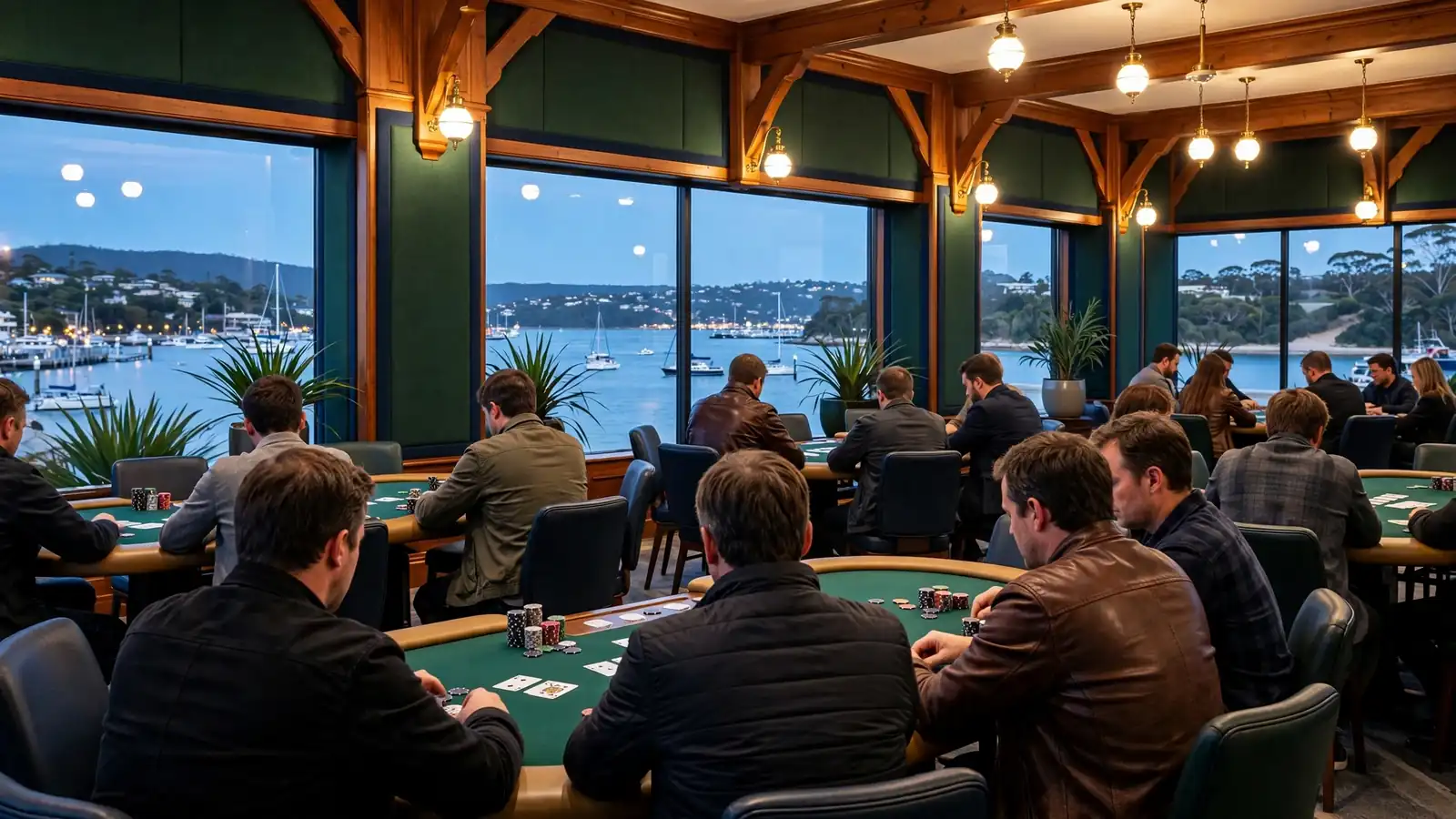
A casino name can make poker sound like a given. It isn’t. A venue might have gaming facilities without running live poker, and a poker room, if one exists, does not automatically mean there is a tournament on the night you want to go. Treat both as details to settle before making poker the reason for your visit.
For Hobart, the useful distinction is between cash games, scheduled tournaments and poker-themed events. They are not interchangeable. Cash games involve players joining a table under the venue’s rules; tournaments have a stated format and start time; an occasional event may be advertised separately and may not run on a regular schedule. I wouldn’t read “poker” on a general casino page as proof that all three are available.
If you’re checking whether there is a dedicated poker room, look for specific signs: a description of the room, how games are organised, and current information about when it operates. If the venue’s own information does not spell those things out, ask the venue directly before travelling. That is less glamorous than turning up hopeful. It is also how you avoid building an evening around a table that may not be running.
If you’re looking for an online casino option while in Hobart, use this list as a starting point and check the terms and availability for Australia before signing up.
LuckyVibe
LuckyVibe lists a Curaçao Gaming Control Board licence, OGL/2023/176/0095, held by Hollycorn N.V. You can use that licence detail as a point to check when assessing the operator.
Vegaz Casino
Vegaz Casino lists Curaçao licence OGL/2024/1335/0780 and a minimum deposit of EUR 20. Check the currency and current terms before depositing.
LevelUp Casino
LevelUp Casino lists Curaçao eGaming licence OGL/2023/174/0082, held by Dama N.V., and a minimum deposit of A$15. You can review these details when considering the casino.
SkyCrown
SkyCrown lists a Tobique Gaming Commission licence and a minimum deposit of A$30. Its stated payout times are around 10–15 minutes for crypto and 1–5 days for fiat.
SpinsUp
SpinsUp lists Curaçao Gaming Control Board licence OGL/2023/174/0082, held by Dama N.V. The licence is the specific detail available for you to review.
JustCasino
JustCasino lists a Curaçao Gaming Control Board licence. You can check this licensing detail as part of your assessment.
Uptown Pokies
Uptown Pokies operates under a Curaçao licence and has been operating since 2017. Its stated minimum deposit is A$20.
Roby Casino
Roby Casino lists a Curaçao eGaming licence held by Roby Games Ltd. You can use the named licence holder as a reference when reviewing the operator.
Ricky Casino
Ricky Casino lists a minimum deposit of A$20, or A$30 to qualify for the bonus. Its stated payout times are under one hour for crypto and 1–3 business days for PayID.
MrPacho
MrPacho lists a minimum deposit of A$30. Its stated payout times are 30–120 minutes for crypto and 24–72 hours for fiat.
Tournament details need the same care. A useful listing should identify the event and its date, along with any entry conditions and registration instructions. A past result or old event notice does not tell you what is scheduled now. Nor does a general statement about poker establish that there is a tournament tonight. If you are travelling specifically to play, get confirmation for the date you have in mind.
I’ve made the mistake of treating a broad venue description as a plan. It isn’t one. A quick check can clarify whether poker is offered, whether a tournament is actually scheduled, and whether you need to register in advance. If you can’t get a clear answer, keep your plans flexible rather than assuming you will be seated when you arrive.
The same goes for searches for casino “rooms”. That phrase can mean a poker room, hotel accommodation, or simply a room inside the venue. In a poker context, make sure the information is actually about live play: a hotel room listing tells you nothing about poker, and a general casino description tells you nothing about tournament dates. Those are separate questions.
Some people also look for a sports bar alongside poker, or want to know whether the venue is open today. Those details do not establish that poker is available. A bar and a poker room are different facilities; opening status and poker schedules are different pieces of information. Check each one for the day you plan to go, rather than letting an answer about one stand in for the others.
If live poker is available, ask about the practical rules before you sit down: how a game is started, whether seats can be reserved, what identification is required, and what payment methods the venue accepts. Do not assume that rules used by clubs elsewhere in Australia apply to a Hobart venue. For instance, NSW requirements concerning poker machines are not a basis for describing poker or entry rules in Tasmania. Different state, different question.
Keep the boundary clear between live poker at a physical venue and online poker. Under the Interactive Gambling Act 2001, operators cannot provide real-money online poker to people in Australia. That restriction concerns online services; it should not be confused with whether a physical venue offers a live poker game. Likewise, an online poker page is not evidence of a local room or a scheduled event.
My rule is simple: confirm the game, confirm the date, and confirm the arrangements with the venue before setting off. If poker is only one part of the night, have another plan that does not depend on a tournament being underway. No guesswork needed.
Planning a stay around a casino is partly about distance and partly about the small print. I’ve learned not to treat “nearby” as a useful measure on its own. A place can look close on a map and still be awkward for the route you actually need, especially if you’re arriving with luggage or heading back late.
Start by checking the casino’s location against the accommodation address using a map, then look at the walking route as well as the straight-line distance. If you expect to drive, check the route and parking arrangements at both ends. “Parking available” can mean different things, so establish whether a space is included, needs to be booked, or comes with a separate charge. Don’t build the plan around an assumption.
For accommodation near Hobart Casino, compare the full stay rather than the headline nightly rate. Look at taxes and fees, cancellation terms, check-in arrangements and whether the booking conditions suit your plans. A low advertised price can stop looking attractive once the extras are added. I’ve made that mistake before. Cheap is not always cheap.
A Hobart casino accommodation deal may refer to a room rate, a package, or a promotion connected with a stay. Those are not interchangeable. Read what the offer actually includes, which dates it covers, and what happens if your plans change. If the wording is broad, get the details from the accommodation provider before paying rather than relying on a banner or a short summary.
The same goes for casino promotions. Don’t assume that an offer connected with the venue also pays for accommodation, reduces a room rate, or applies automatically to every booking. Check the terms attached to the specific offer and keep a copy of what you booked. “Special” is marketing language; the conditions are the part that affects your trip.
It also helps to separate the stay from the gambling decision. A room booking does not make a promotion worthwhile, and a promotion should not decide where you sleep. I’ve found it easier to compare accommodation on location, total cost and booking conditions first, then consider any separate offer on its own merits. Keep the budget for the trip clear. Don’t spend more because an advert makes the whole package sound like a bargain.
Before you commit, confirm the address shown on the booking and how you’ll get from there to the casino. Check whether your planned transport is available for the times you need it, and don’t assume that the venue’s opening schedule or parking arrangements will match your plans. Those details can change, so verify them close to your visit.
If you’re comparing several options, use the same checklist for each: total price, location, route, parking, cancellation conditions and what the offer includes. That gives you a more useful comparison than a row of promotional rates. Save the confirmation and any terms that matter, especially if the booking depends on a promotion.
The aim isn’t to find a deal that sounds impressive. It’s to avoid paying for something you didn’t expect, or choosing a place that makes the visit harder than it needs to be. Check the details, then book what fits. No guesswork.
A casino and a hotel can share a name, a site or a booking page, but that does not automatically mean the casino operates guest rooms. If you’re considering a stay connected to Hobart Casino, first establish what the accommodation actually is: rooms run by the venue, a separate hotel nearby, or simply a property that uses the casino as a local landmark.
That distinction matters when you book. “Casino hotel” can sound like one straightforward package, but the words alone don’t tell you who manages the room, what facilities are included or how far you’ll need to travel between the accommodation and the venue. I’ve been caught before by assuming that a place mentioned alongside an attraction was part of the same operation. It wasn’t. The label did more work than the booking details.
Before paying, look for the property’s full name and address, the business responsible for the booking, and a clear description of the room you’re selecting. Check whether the room is actually on the casino premises or at a separate address. If the listing is vague, ask the property to confirm that point in writing.
Read the room conditions rather than relying on a headline. Look for what the rate includes, when payment is due, and the cancellation and change rules. Check whether the room type and bed arrangement suit your plans, and whether any facilities mentioned are available to guests or merely located elsewhere. Don’t assume a photo of a building, lounge or view shows exactly what your booking includes.
If a listing promises a special casino stay, treat “special” as a sales word until the terms spell out the benefit. It might refer to a location, a bundle or a promotion; the wording itself doesn’t tell you which. Confirm the details with the business taking your reservation, not just with a third-party listing that may use a broad description.
People looking for hotels near the casino may be happy with accommodation in the surrounding area. Someone looking for a hotel at the casino has a different practical question: can they stay in the same complex, and what is the route between their room and the venue? Don’t let a map pin or a nearby listing answer that for you. Check the actual address and travel arrangements before you commit.
I’d also keep room availability separate from the venue’s schedule. A hotel reservation does not establish that the casino is open at a particular time, and it doesn’t confirm that a show is scheduled during your stay. Those details need their own current confirmation from the relevant business. A room booking can be settled while the evening plan is not.
For a Hobart casino hotel stay, the sensible approach is plain: confirm that the accommodation exists under the name being advertised, identify who operates it, and make sure the room details match what you intend to book. If those basics are hard to pin down, pause before entering payment details. No glossy description fixes a booking you misunderstood.
Parking, dining, bingo and online play are easy to bundle together when you are planning a casino visit, but they need different checks. A search for parking is about getting to a physical venue. A search for online casino games raises a legal issue that is separate from anything happening inside a Hobart venue.
If you are deciding whether to drive, don’t assume that parking is free, that valet parking is available, or that spaces can be found at the time you arrive. Those are practical details worth confirming directly with the venue before setting out. “Free parking” sounds like a useful extra; without current confirmation, it is just a promise you should not plan around.
The same goes for dining. A casino visit may prompt you to look for somewhere to eat, but a search result or old listing is not enough to establish what is currently available, what it serves or when it is open. Check current venue information before making dinner plans. I have learned the annoying way that an assumption about a place being open can turn into a different plan altogether.
Bingo is another separate question. Don’t treat a bingo listing as proof that a session is running on the day you want to go. Confirm whether it is offered and check the current schedule with the venue. Parking, food and bingo are not interchangeable amenities, and a general casino listing may not answer any of those specifics.
The phrase “Hobart online casino” can sound like a request for a digital version of a local venue. But the law is not determined by whether a site uses a Hobart name or looks connected to a physical casino. Under Australia’s Interactive Gambling Act, an Australian-run operator cannot provide real-money online casino services to people in Australia. Online casino-style games, including pokies, blackjack and roulette, are restricted when offered by operators based here.
Offshore sites are a different category, but that does not make them Australian-regulated services. Their position is a legal grey area: it is technically not illegal for an Australian player to use one, yet those platforms are not regulated under Australian law. That distinction matters if something goes wrong. A familiar-looking brand or local wording is not a substitute for Australian oversight.
I would not read an online listing as a recommendation or assume that a site is lawful simply because it accepts Australian visitors. Nor should an online service be confused with the physical venue’s parking, food or entertainment arrangements. Different questions. Different checks.
For a visit in Hobart, confirm the venue details directly before relying on parking, dining or bingo information. For online play, keep the legal distinction clear: Australian-based operators cannot offer real-money online casino games to people in Australia, while offshore platforms do not have Australian regulation. That is a caveat worth noticing before clicking.
A phone number in an old directory can look convincing and still send you in the wrong direction. I treat contact details as something to confirm close to the day, not as a permanent feature of a saved page. If you need to ask about entry, a bar, parking or a particular game, use a contact channel published by the venue itself and check that it refers to the Hobart location.
That matters when you’re planning around a specific table game. Searching for baccarat or craps doesn’t confirm that either is currently offered at the venue, or that a table will be open when you arrive. Ask directly about availability and any conditions for playing. A casino name alone isn’t a timetable.
For directions, use a current map listing tied to the venue’s own address, then compare it with the venue’s own travel information if available. Don’t rely on a map pin alone: listings can be outdated, and a similarly named result can take you somewhere else. I’ve learned not to make a trip based on the first result that looks right. Check the destination before leaving.
The same goes for the car park. Confirm whether parking is available to visitors, where its entrance is, and whether any access arrangements apply. A map may show parking nearby without showing whether it belongs to the casino or is open to the public. Don’t assume “close by” means you can use it.
If you plan to have a drink at a bar, verify that it is operating and accessible on your visit. A venue listing or older photo can show a bar without telling you whether it is open that day, whether access is limited, or whether you need to meet an entry condition. Make the check before you build the evening around it.
Concert listings need the same care. Look for an announcement tied to the venue and the specific performance, rather than treating an old event page or an unconfirmed listing as proof that something is on. If the event matters to your plans, contact the venue through its current official channel and confirm the practical details directly.
Before heading out, make sure you have:
If a directory, map result and event page disagree, don’t pick whichever answer is most convenient. Get confirmation from the venue before travelling. It’s a small pause, but better than arriving with the wrong address, no usable parking plan or plans for a bar or event that aren’t actually available.
A breakfast mention can mean a meal served at a venue, a package tied to a stay, or an old promotion. Those are different things. I’ve learned not to read “breakfast included” as a promise until I know what it applies to, when it is available and whether it is part of the price I’m considering. The same goes for a buffet: the word alone says nothing about service times, current availability or what a booking covers.
For a Hobart casino breakfast or buffet, look for a current listing from the venue and check the details before making plans around it. An old review, an image of a spread or a booking-platform label can linger after arrangements change. If the information is unclear, ask directly whether breakfast is being served on the day you want to visit and whether a reservation is needed. No guesswork. Not worth the detour.
“Resort” is another word that can carry more weight than it earns. It may be used in a search or description without telling you what facilities are actually operating, or whether a particular offer includes access to them. I’d treat it as a label, not a checklist of amenities. Confirm the specific thing you want before paying or planning around it.
Check current venue listings for service times, availability, and whether a reservation is required.
Treat "resort" as a label; confirm specific operating facilities before paying or planning.
Verify membership rules, how benefits are earned, and the exact terms of any promotion.
Rewards need the same plain reading. A rewards programme, if one is offered, can have its own membership rules and conditions; the name alone does not tell you what benefits apply, how they are earned or whether they can be used for a particular visit. I would not count a promotion as a saving until its terms say exactly what you receive and what you need to do. “Exclusive” can mean exclusive conditions.
The useful habit is to separate the questions. Is breakfast available? Is it a buffet? Does a resort-style offer include a specific facility? Are rewards usable for the booking or visit in mind? A clear answer to one does not settle the others. Keep a note of the terms shown when you book, especially if a promotion is involved, and check that they still match what you were told.
If you are looking for work rather than a meal or a perk, treat job listings separately from venue offers. Search for a current vacancy through an official hiring channel and read the role, location and application details carefully. A mention of casino jobs in an old listing or third-party post is not confirmation that the position is still open. Don’t send personal documents or payment in response to an informal message claiming to recruit for the venue.
I’ve clicked through enough glossy offers to know the headline is the easy part. The conditions are where the actual answer lives. For breakfast, buffet access, resort facilities, rewards and employment, confirm the specific arrangement directly before you build a visit or decision around it. Skip the assumption. Verify the detail.
If you’re trying to work out whether Hobart Casino is open, don’t rely on an old directory entry or a review that happens to say “open.” That can mean the venue was operating when the page was updated, not that its hours are current. I’ve made that mistake with venues before: a confident-looking listing can be stale. Check for a recent notice from the venue itself before making the trip. No guesswork.
The same caution applies to reports about a reopening. A headline, proposal or social post is not the same thing as confirmation that the venue has reopened to visitors. Look for a dated announcement that clearly says what has changed and when the public can attend. If there’s no such notice, I’d treat the status as unconfirmed rather than plan around a rumour.
Development news can describe very different stages: an idea, an application, work in progress or a completed project. Those are not interchangeable. When you see a claim about changes at the casino, check whether it identifies the stage and has a recent date. A promise of future work doesn’t tell you what facilities or activities are available now.
Employment searches need the same distinction. A general careers page or an old job advert does not confirm that a particular role is currently open. Look for a live listing with a closing date or other clear application details, and check that it is specifically connected to the venue. Don’t send personal information through an unfamiliar listing just because it uses the casino’s name.
Entertainment and event listings should tell you what is happening and when. If a page has no date, or appears to describe a past event, it cannot confirm what’s on now. I’d want to see a current listing from the organiser or venue before treating a show, activity or event as booked and available. “Coming soon” is not a schedule.
Reviews are useful for impressions, but they’re not a reliable source for today’s operating status, event calendar or employment openings. Even a detailed account may describe one visit from a different period. Check when it was posted, and separate personal opinion from details that can change.
A menu mention can also age quickly, so don’t use an old review to infer current service or availability. For present-day plans, seek a current venue notice rather than filling gaps with assumptions. If the information you find is undated or contradictory, pause and confirm directly before travelling or applying. A little checking beats a wasted trip.
A map pin can look authoritative and still leave you with the wrong entrance, an outdated listing or a venue name that has changed. Before setting out, check the casino’s own current address and directions, then compare them with a reliable map. I’ve learned not to treat an old directory entry as a plan. A quick check first saves a pointless detour.
The same caution applies to searches for a day spa or spa facilities at the casino. Don’t build your day around a treatment, poolside service or wellness area unless the venue itself confirms it is available. A listing elsewhere may be stale, may describe a nearby business, or may refer to a separate property. “On-site” is a useful phrase only when the venue says what it means.
Bars are another detail worth checking directly. A search result may suggest there are bars at or near the casino, but that alone doesn’t establish which spaces are operating, what their entry rules are, or whether a particular bar is open when you plan to visit. Check the venue’s current information rather than relying on a photo or a review with no clear date. Small distinction. Big difference.
For the dress code, look for the casino’s own entry guidance. Don’t assume that a rule from another Australian venue applies in Hobart, and don’t rely on an old social post as policy. If the official guidance is unclear, contact the venue before travelling; turning up dressed for a different kind of night is an avoidable hassle.
The same goes for careers. If you’re looking for work, use an official careers page or a direct venue channel to check whether roles are currently advertised and how applications are handled. A search listing or recruitment post may no longer be current. I wouldn’t send personal details through a third-party link unless it clearly leads to the venue or its authorised recruiter.
And when you see “casino games”, pin down what the page is actually describing. It may refer to games offered at a physical venue, not an online service. Under the Interactive Gambling Act 2001, operators cannot provide real-money online casino games to people in Australia. That’s separate from checking what a local venue offers in person.
For each of these details, the sensible move is the same: confirm it through a current, direct venue channel before making plans. Don’t let a confident-looking listing do the checking for you.
A restaurant search tied to Hobart Casino can mean two different things: a place to eat inside the venue, or somewhere nearby before or after a visit. I wouldn’t treat those as interchangeable. A restaurant described as “near” a casino may be elsewhere in Hobart, while a venue’s general dining information does not establish that a particular restaurant is operating inside the casino.
I’ve learned not to plan a meal around a polished label. “Dining” can mean a full restaurant, a limited menu, or a service that changes with the day. Before making plans, look for a current listing that identifies the restaurant itself and confirms it belongs to the venue you intend to visit. Then check the details that affect your evening: whether it is open on your chosen day, what food is served, whether bookings are accepted, and whether access is restricted to casino guests or members.
That last point matters. A restaurant can be physically close to a casino without being part of it, and a listing for a casino in Hobart, Australia, is not automatically a restaurant listing. If the information only says “food” or “dining,” don’t fill in the blanks with assumptions about a sit-down meal, a menu, or service times. Check the specific restaurant’s own current information before setting off.
The rooftop-bar searches need the same care, but they are not proof of a restaurant. A bar may have a different offer, access policy, and operating schedule from a dining room. I’d confirm what the listing actually describes rather than relying on a photo or a broad venue tag. No point arriving hungry because a bar result looked like dinner.
For restaurants near the casino, check the location as well as the name. “Nearby” is a useful starting point, not a measure of walking distance or a promise that somewhere will be open when you arrive. Confirm the address and current hours directly with the restaurant, especially if your plans depend on a late meal or a booking.
The sensible approach is boring, but it saves a wasted trip: identify the exact place, check its current menu and hours, and confirm any booking or entry conditions. Don’t assume the casino’s name tells you what kind of meal is available. Details first. Then dinner.
A request for food at Hobart Casino can mean a basic meal, somewhere to sit with a snack, or a dedicated food court. Those are different things, and I wouldn’t treat one as proof of the others. A food court suggests a particular style of setup; general food options could mean something else entirely.
I’ve learned not to turn a venue’s broad reputation into a promise about what’s on site. If you’re planning around a meal, look for current, venue-published details that name the facility and explain what it offers. If those details aren’t there, keep your plans flexible rather than assuming you’ll find a food court when you arrive. “Food available” is not a useful guarantee by itself.
The pool question needs the same care. A pool is a specific facility, not something you can infer from a casino’s name or from nearby accommodation. I wouldn’t build a day around swimming unless the venue explicitly confirms access, location and any conditions that apply. Otherwise, it’s an assumption with wet consequences.
These details matter because the labels can blur together. Food, a food court and a pool each need their own confirmation; one amenity doesn’t establish another. When I’m checking a place before heading out, I look for wording that identifies the actual facility, not vague promotional language. If the information is unclear, contacting the venue directly is safer than relying on an old listing or an image that may not show what’s currently available.
Keep the plan simple: confirm the specific thing you want, and have a fallback if it isn’t clearly listed. No guesswork needed.
Created by the ”Richard Casino” editorial team.