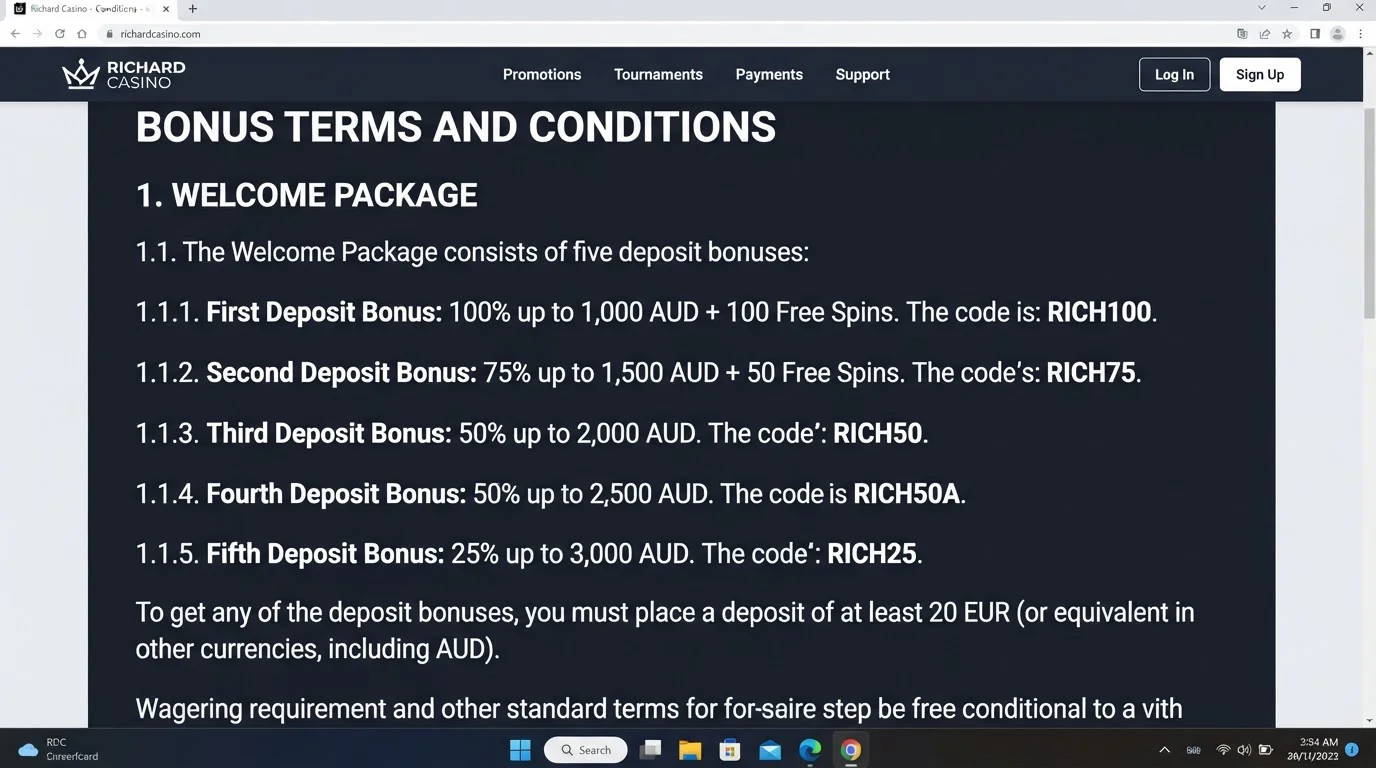
The advertised balance may be bonus funds, with wagering terms determining whether winnings can be withdrawn.

A headline promising a $200 casino bonus can sound like someone has put cash in your pocket. I used to read it that way. The catch is in the word “bonus”: it describes an offer attached to an account, not money you can necessarily withdraw or spend wherever you like.
A no-deposit offer may give you free cash or free spins after you create an account without making a deposit. That is the basic distinction from an offer that asks you to put money in first. But the amount in the headline does not tell you what you will be able to cash out. It may describe bonus funds for play, rather than withdrawable cash.
That difference matters more than the big number. An advertised $200 bonus might be presented as a balance you can use, but the terms can determine whether winnings from it become withdrawable and what you must do before requesting a cashout. So I treat the figure as the starting point for reading an offer, not as a promise of $200 in my bank account.
If you’re looking for a $200 no-deposit casino bonus in Australia in 2026, check each offer’s terms and eligibility before you sign up. This list gives you a few verified details to help you assess the operators.
LuckyVibe
LuckyVibe is listed with a Curacao Gaming Control Board licence, held by Hollycorn N.V. You can use that licensing detail as one point to check when assessing the casino.
Vegaz Casino
Vegaz Casino lists a Curacao licence and a minimum deposit of EUR 20. Check the offer terms to see how that deposit requirement relates to any bonus.
LevelUp Casino
LevelUp Casino lists a Curacao eGaming licence held by Dama N.V. and a minimum deposit of A$15, giving you two concrete details to check against the bonus terms.
SkyCrown
SkyCrown lists a Tobique Gaming Commission licence and estimated payout speeds of around 10–15 minutes for crypto and 1–5 days for fiat. Its stated minimum deposit is A$30.
SpinsUp
SpinsUp lists a Curacao Gaming Control Board licence held by Dama N.V. You can verify that licensing information when considering the casino.
JustCasino
JustCasino is listed with a Curacao Gaming Control Board licence. That is the only specific operator detail provided here, so check the casino’s offer terms for further information.
Uptown Pokies
Uptown Pokies is listed as operating since 2017 under a Curacao licence, with a minimum deposit of A$20. Check its current terms to confirm how deposits and any bonus are handled.
Roby Casino
Roby Casino lists a Curacao eGaming licence held by Roby Games Ltd. You can use that information as a starting point for checking the operator.
Ricky Casino
Ricky Casino lists crypto payouts in under 1 hour and PayID payouts in 1–3 business days. The minimum deposit is A$20, or A$30 to qualify for the bonus.
MrPacho
MrPacho lists crypto payout times of 30–120 minutes and fiat payout times of 24–72 hours. Its stated minimum deposit is A$30.
A wagering requirement is one reason the headline and the eventual cashout can be far apart. It means you must place bets totalling a specified amount before a withdrawal is allowed. The requirement may be tied to the bonus amount, so a large-looking bonus can create a large amount of betting to complete.
Here is a smaller illustration. If a no-deposit offer gives you AU$20 and sets wagering at 40×, you would need to place AU$800 in bets before cashout. That is the total value of bets, not a bill for AU$800 and not a guarantee you will finish with that amount. Bets can win or lose as you play; the wagering target simply measures how much you have staked.
I have made the mistake of seeing a bonus balance and mentally counting it as money already won. It isn’t. The amount available to play with, the amount you may eventually be able to withdraw, and the amount you actually keep are different things. A wagering requirement can make the gap obvious. A cashout cap or other conditions can affect the outcome too, so the advertised value by itself is not enough to judge what an offer gives you.
Short version: not cash.
The same caution applies when a page describes a casino with a $200 bonus. That wording can cover different kinds of promotions. One may be a no-deposit offer; another may be a deposit-related promotion. The headline alone does not tell you which one you are looking at, or whether the advertised amount is cash, spins, or a bonus balance with conditions attached.
I would not assume that a genuine AU$200 no-deposit offer is available just because a page uses that figure. The useful question is what the offer actually credits and what conditions apply to it. “Free” can mean there is no deposit required to receive the offer; it does not automatically mean there is no wagering requirement or that any resulting balance can be withdrawn straight away.
Free spins are also not the same thing as free cash. They give you turns on a game, while a cash-style bonus gives you an amount of bonus funds to use. Either can be advertised with a dollar value, but that label does not make the value equivalent to withdrawable money. The form of the offer matters.
When I look at a casino bonus of $200, I start by separating the headline from the practical value: what is being offered, whether a deposit is needed, and what must happen before a withdrawal. If those details are not clear, the headline cannot answer the question for me. A large number looks good on a banner. The conditions decide what it means.
A sign-up offer can look simple from the outside: create an account and receive something to play with. In practice, the offer may be added automatically, or it may ask you to enter a bonus code during registration or later in the cashier. A specialist review describes both routes, so don’t assume that signing up alone activates every offer.
Sign-Up Sequence
Review Terms
Read the activation steps and check if the offer requires a bonus code or is automatic.
Register Account
Complete the registration form and enter any required code in the specified field.
Verify Email
Open the verification email promptly and follow the link, typically within 24 hours.
Confirm Credit
Check the account's promotion or bonus area to ensure the offer has appeared.
I’ve made that mistake myself: I registered, saw no bonus, and only then went back to reread the offer. Before you start, check the instructions attached to that specific promotion. If it names a code, copy it carefully into the stated field. If it says the credit is automatic, look for confirmation in the account rather than entering a code you found elsewhere. A code can be specific to an offer; treating it as a universal sign-up key is a good way to get nowhere.
Start at the offer’s own terms and read the activation steps before filling in the registration form. Check whether the promotion is for free spins or a no-deposit chip, and whether the page tells you to enter a code during sign-up or in the cashier. Then complete the account details as requested and watch for any confirmation message.
Email verification can be part of the process. One specialist review says the verification link for the offer it examined had to be used within 24 hours. That is a reported condition, not a rule to assume applies everywhere. If an offer asks you to verify your email, open the message promptly and follow the link; if it does not arrive, check your junk folder and the address you entered. Don’t rely on an old link or assume that an account is verified just because registration went through.
After that, check the account’s promotion or bonus area for a status update. If the offer has not appeared, compare the account instructions with the promotion’s terms before trying to register again or contacting support. Repeating sign-up steps can create confusion, especially if you already have an account.
Free spins are individual plays, not a cash balance you can use wherever you like. A specialist review says the spins it examined were tied to a particular pokie. That means the offer may direct you to one named game rather than letting you choose any game in the lobby. Check the title shown in the promotion and use the route given by the casino; searching for a different pokie may not activate the spins.
A no-deposit chip is a different format. The same kind of review describes some such bonuses as usable on selected games, rather than being a set of spins on one title. “Selected” matters: it does not mean every game is eligible. Read the offer’s instructions before launching a game, and don’t assume the chip and spins can be swapped or used in the same way.
If you are looking at a headline promising a free $200 sign-up bonus, first establish what the offer actually provides. The headline might refer to spins, a chip, or another promotion format; the registration steps and eligible games can differ. The advertised figure alone does not tell you which button to press or what will appear in your account. Small print first. Then the click.
A bonus balance can look ready to play, but the game you choose affects whether your wagers help meet its requirements. I learned that the annoying way: I assumed every game in the lobby moved the balance along. It doesn’t. The terms can assign different contribution rates to different games, or exclude some games altogether.
Pokies generally contribute their full wager towards a wagering requirement. So, if the terms say a pokie contributes 100%, each eligible wager counts in full. That does not mean a win is guaranteed, or that the amount wagered is the amount you can withdraw. It only describes how the casino counts eligible play towards its requirement.
Table games can work very differently. Blackjack, baccarat and roulette contribute between 0% and 10% in most cases. At the lower end, a wager may do almost nothing to advance the requirement. I used to treat the game list as a suggestion. Bad read. If you play a table game without checking its contribution, you may spend time and balance while making little progress.
Some games may not count at all. Progressive jackpots, table games and live dealer titles are commonly excluded from no-deposit offers. The wording varies, so check the terms attached to the specific offer rather than assuming that a game is eligible because it appears alongside pokies in the same lobby. An excluded game can leave your wagering progress unchanged, and the offer may set out consequences for using it.
That distinction matters when you see a headline about a $200 no-deposit bonus for Australian pokies. The headline tells you the advertised amount, not which games qualify. A code or offer described as a welcome bonus does not tell you whether every pokie contributes equally, either. The game rules live in the bonus terms, not in the promotional label.
Before starting, look for the eligible-game list and the contribution rate beside each category. Check whether a particular pokie is excluded, whether a table game contributes only a fraction, and whether live dealer games or jackpot titles are ruled out. If the terms are unclear, don’t guess based on the game’s name or appearance. A pokie with a jackpot feature, for example, may be treated differently from other pokies if the offer’s rules say so.
Keep the bonus conditions open while you play. I’ve clicked through long terms too quickly, then had to work out why the progress bar barely moved. The useful question is not simply, “Can I open this game?” It is, “Does this game count, and how much does it count?” Those are different checks.
This applies whether the offer is presented as free cash, spins or a no-deposit chip: the playable games and their contribution rules can shape how wagering progresses. Don’t treat a bonus code as proof that every game is eligible. Read the conditions for the offer itself, and stick to games the terms clearly include. If the rules exclude a title, switching to it for variety can put the bonus balance at risk.
A simple habit helps: identify the eligible pokies first, then avoid excluded categories unless the offer explicitly says otherwise. No guesswork.
A “$200 no-deposit bonus” sounds like a balance you can claim and then cash out. I’d read it as a headline, not a promise of $200 in withdrawable money. The phrase describes an advertised offer; it does not establish that a particular casino currently gives Australian players that amount, or that the bonus is paid as cash.
The first thing I’d check is the wagering requirement: how much you must bet before winnings become eligible for withdrawal. A specialist review of AU-facing offers reports requirements in the 40× to 60× range. Treat that as a reported range, not a rule for every offer. The operator’s terms for the specific promotion are what matter.
If a requirement were calculated against the full $200 bonus, 40× would mean $8,000 in bets; 60× would mean $12,000. That is total wagering, not a bill you pay upfront, but it is still a substantial amount of play attached to the headline. The wording matters too: terms can specify whether the multiplier applies to the bonus, winnings, or another defined amount. I would not assume which one without reading the actual clause.
Then there is the cashout cap. AU-facing offer terms are reported with maximum withdrawal limits ranging from A$50 to A$200 on no-deposit winnings. A cap can make a large displayed balance irrelevant: even if play takes the balance above the limit, the terms may restrict what can be withdrawn. Check whether the cap applies to the bonus winnings, the total balance, or something else. Small print, big difference.
I’ve made the mistake of focusing on the number in the banner and treating the conditions as housekeeping. They are the offer. A large starting figure can sit beside a demanding wagering requirement and a cap that limits the possible cashout. Those conditions pull in opposite directions: one asks for more play, the other can restrict the amount you keep.
So if you are looking for a $200 no-deposit casino offer in Australia, separate three things before you get attached to the headline: whether the offer is actually available to you, what amount the wagering multiplier uses, and the maximum cashout on winnings. Don’t infer availability from a page title or an old promotion. Offers change, and a number on a promotional page is not proof that its conditions are still active.
My rule now is simple: I read the cap and the multiplier before I think about the bonus amount. If either is unclear, I treat the headline as advertising, not money in my pocket. That sounds less exciting. It is also how I avoid mistaking a large bonus figure for a large withdrawal.
A “$200 welcome bonus” sounds like something you receive just for opening an account. I’ve learned to read the next line before believing the headline. A welcome offer can be tied to your first deposit, so the advertised bonus may not be available until you put in your own money.
That makes it different from a genuine no-deposit offer, which may be credited without a deposit. The wording can blur the distinction: “welcome” describes when an offer is presented, not whether it is free. A casino $200 welcome bonus could therefore mean a deposit-linked promotion rather than $200 in account credit for signing up.
Some offers require a minimum deposit to activate. One specialist review described a listed offer with a minimum deposit of A$5. Treat that as a condition to check on the specific offer, not as a standard applying everywhere. If you see a similar claim, look for the qualifying deposit in the promotion’s terms before you register or transfer money.
A “200% bonus” is another kind of offer. The percentage describes how the bonus relates to a qualifying deposit; it does not, by itself, tell you the amount you need to deposit or guarantee a fixed bonus. The offer may set a minimum, a maximum qualifying deposit, or both. Without those details, a large percentage is mostly decoration.
I used to read the headline and assume the money would simply appear. That was the wrong order. First work out whether the offer is deposit-based, then check what makes you eligible and what you must do to activate it. If the condition is unclear, the headline has not told you enough.
Other terms can narrow the offer further. A promotion may be limited to particular games, exclude some kinds of play, or expire after a stated period. It may also come with wagering requirements and a maximum cashout cap. Those conditions affect how the bonus can be used and what can happen to winnings, so don’t treat “$200” as the whole deal. Read the full terms attached to the specific promotion, not just the banner or a short description.
Check whether the offer is for new customers, whether it applies to your account, and whether the stated deposit qualifies. A welcome bonus can be unavailable if you have already claimed another promotion or if your account does not meet the offer’s conditions. The exact rules vary, so don’t assume a deal described elsewhere applies to the one in front of you.
If you came looking for a $200 casino bonus, the useful distinction is simple: does it arrive without a deposit, or does it depend on one? A large label can hide that difference. Check the activation condition before treating the bonus as yours. No surprises—if you read first.
PayID can make a deposit look simpler than the withdrawal that follows. At Australian banks, a PayID transfer is described as free and instant. You send it using an email address or mobile number, rather than entering BSB and account digits. That can make the payment step feel almost frictionless.
But a quick deposit does not tell you how money can come back out. At most offshore casinos serving Australian players, withdrawals are handled by bank transfer instead of PayID. So the route into an account and the route out may be different, with separate processing steps and requirements. I learnt not to treat a familiar payment button as proof that cashing out will be just as straightforward.
The distinction matters if you are looking at a deposit offer or a match bonus. A deposit bonus is not the same thing as a no-deposit offer: the first may depend on paying in before any bonus is credited. And even where a balance includes bonus winnings, the payment method alone does not establish that the balance is ready to withdraw. The offer terms and the operator’s withdrawal conditions still matter.
There is another wrinkle with no-deposit winnings. A specialist review reports that an operator may ask for a minimum PayID deposit to link a bank account before allowing a withdrawal. That is a condition to check in the specific terms, not something to assume applies to every offer. If you accepted a bonus because it appeared to require no payment, discovering a deposit condition at cashout can feel like the rules changed after the fact. Read the withdrawal section before registering, not when you are already trying to get money out.
I have made that mistake in spirit, if not with this exact payment method: I focused on the easy part and left the awkward part for later. “Instant” describes the transfer into the account; it says nothing by itself about a bank-transfer withdrawal, approval, or whether a bonus balance qualifies. Different stages. Different rules.
There is also a broader point for Australians: a payment option being available does not make the underlying online casino service lawful to provide here. The Interactive Gambling Act 2001 prohibits operators from providing real-money online casino games to people physically in Australia. PayID is simply a way to move funds between accounts; it does not change that legal position or add consumer protections to an offshore transaction.
Before considering any payment, check whether a deposit is required to activate the offer, which withdrawal route is used, and whether a deposit is required before bonus winnings can be released. If those conditions are unclear, a fast payment is no comfort. The money may go in seconds; getting it back can be a different matter.
A $200 online casino bonus can look like a straightforward offer, but the amount and the bonus label do not change the legal position in Australia. The key distinction is who the law is aimed at: the Interactive Gambling Act 2001 prohibits operators from providing online casino games to people in Australia. That includes real-money casino play, not merely the promotion attached to an account.
The rule applies whether an offer is described as a no-deposit bonus, a deposit match or a welcome reward. A $200 deposit bonus does not turn an otherwise prohibited service into a permitted one. Nor does using an offshore operator make the service lawful to provide to people physically in Australia.
It is easy to read a ban on providing a service as though it automatically makes every customer a criminal. That is not the stated position here. The Act targets the operators providing the prohibited service; Australian residents do not face criminal or civil penalties simply for accessing, registering with or playing at an offshore online casino.
That distinction is important, but it is not an endorsement or a promise that using such a site is safe. Regulators actively block and enforce against prohibited offshore services, and the absence of player penalties does not mean an operator is authorised to serve Australians. I used to treat “offshore” as a kind of legal shortcut. It isn’t.
A casino may still display an offer to Australians, but seeing a promotion does not settle whether the operator may legally provide its games here. The same goes for an online bonus casino advertising a $200 reward: the size of the offer is beside the point when the underlying service is prohibited.
Keep the two questions separate. First, what does the Australian law say about providing online casino games to people in the country? It prohibits that provision. Second, what is the stated consequence for a resident who accesses an offshore casino? The stated position is that the resident faces no criminal or civil penalty for doing so.
That does not create Australian consumer protections for a player dealing with an offshore operator, and it does not guarantee access to a site or a bonus. A promotion is not proof of approval, and an account registration is not proof that the service is lawful to offer in Australia.
So if you come across an online casino $200 bonus, read it as an advertisement, not as evidence that the casino has Australian authorisation. The legal issue sits with the operator’s provision of the games; the consumer’s stated legal position is different. That is the line worth remembering.
A first-deposit offer can look like a straightforward match: add money, receive bonus funds, then play pokies. But once a bonus is active, the small rules can matter more than the headline. I’ve learned not to start spinning until I know the stake ceiling and when the offer expires. “Flexible” can mean anything the terms allow.
One specialist review describes maximum bets on bonus funds as ranging from A$5 to A$6.50. That is a report from one review, not a rule you can assume applies to every offer. Your casino’s own terms set the limit. Check whether it applies to each spin, and whether it covers both your deposit and the bonus balance. If you exceed the stated maximum while wagering, the bonus can be voided. The terms may also say winnings attached to it are lost.
That is an easy mistake to make when you change bet size without thinking. I’d check the limit before loading a game, then keep each stake below it rather than trying to sit right on the boundary. Even a small overstep can matter. No clever recovery spin fixes that.
The clock deserves the same attention. A specialist review reports a seven-day validity period for most no-deposit cash bonuses and a 72-hour expiry for free spins. Those timings are not a promise about every promotion, and they may not describe a first-deposit offer. Treat them as a reason to read the specific offer’s expiry terms, not as a countdown you can safely assume. Look for when the period starts: crediting, activation, or another event named in the rules.
If the expiry is close, don’t rush into play before you know the stake limit and which balance is being used. Speed can turn a manageable offer into a forfeited one. A timer is not a reason to ignore the conditions.
Free spins and bonus funds can have separate clocks or separate rules. The spins may expire while another part of the promotion remains active, or the reverse may apply; the offer terms determine what happens. Check the expiry for each component and make a note of it. If the terms are unclear, contacting support before playing is safer than guessing after a balance disappears.
The same habit applies to a promotion described as a $200 first-deposit bonus: the advertised amount tells you little about how long you have or what stake is permitted. Read the bonus-specific conditions before you play, and keep to the stated maximum on every spin. I’ve rushed past that detail before. Costly lesson.
When I see a large no-deposit figure, I now look past the headline first. A $200 offer sounds like a generous starting balance, but that number alone says little about how much you could withdraw. The useful comparison is between the wagering requirement and the cashout cap.
Start with the multiplier and check what amount it applies to. A specialist review describes no-deposit wagering requirements in the range of 40x to 70x; that is a reported range, not a promise that every offer falls within it. Also read whether the calculation is based on the bonus, winnings, or another amount named in the terms. The same multiplier can produce a different total wagering target depending on that base.
The arithmetic makes the difference plain: a $10 bonus with a 50x requirement calls for $500 in bets before withdrawal. That is the amount wagered across play, not a bill you pay upfront, and it does not mean you will finish with $500. I used to see the multiplier and think it was just a small technical hurdle. It isn’t.
Then put the cap beside the bonus amount. No-deposit offers typically cap cashouts between $50 and $100. If an advertised balance is much higher than that limit, the headline may describe what is credited, not what you can take away. A large nominal offer can therefore compare poorly with a smaller one that has a more workable cap.
I’d make a simple side-by-side note for each offer: bonus amount, wagering basis, multiplier, and maximum cashout. If the terms do not make the basis or cap clear, I would not treat the headline as a useful comparison. No need to guess.
That approach is more useful than trying to find the “best” $200 no-deposit offer. The amount can attract attention, but the conditions determine how much play is required and how much could remain eligible for withdrawal. A $200 figure is not automatically $200 in cash, and it does not establish that a particular offer is available or suitable. Compare the route from bonus to possible cashout, not just the starting number.
Seeing a balance after bonus play feels like the hard part is done. I used to read the number on screen as money I could simply take out. It isn’t necessarily. No-deposit winnings can still be subject to wagering requirements and identity checks before a withdrawal is allowed. A displayed balance is not the same as cleared cash.
If a withdrawal request is held, check what the operator says it needs: the wagering conditions completed, the account verified, or both. Make sure the details on your account match your documents, and read the withdrawal rules before sending anything. I learned not to treat “real money” as a promise that the funds are already available. There can be another hurdle.
The minimum cashout can matter just as much. A specialist review of casinos aimed at Australian players reports minimum withdrawal thresholds of A$25 to A$100 at many offshore sites. If your eligible balance sits below the operator’s threshold, you may be unable to withdraw it. That is a frustrating place to land after spending time trying to turn a bonus into cash.
Check the minimum withdrawal and the conditions for bonus winnings before you play, not when you are staring at a pending request. Also distinguish a balance that is still restricted from one the site has approved for payout. Small detail. Big difference.
There is a harder limit to keep in mind: an offshore operator is not backed by Australian consumer protection. If it refuses a withdrawal or disputes your win, you may have no Australian recourse to make it pay. I would not count a possible bonus balance as income, or put money into an account because a large headline figure makes the outcome feel certain. If the terms are unclear, or the operator can change how a withdrawal is handled, walking away is a real option. No easy fix.
You may receive it without depositing, but “free” does not mean the winnings are immediately withdrawable. Wagering requirements, cashout caps, verification and other terms may apply.
Yes, but you generally need to complete the wagering requirement and verify your account first. A maximum cashout limit or minimum withdrawal amount may also restrict what you can take out.
You can generally use eligible pokies, which typically count fully toward wagering, but free spins are often restricted to a specific pokie. Check the offer’s terms for eligible games; progressive jackpots and table games are usually excluded.
Some operators require a minimum PayID deposit to link your bank account before you can withdraw no-deposit bonus winnings. That deposit is a withdrawal condition, not necessarily a requirement to receive the bonus.
A no-deposit bonus may give you free cash or spins after account creation without an initial deposit. Before withdrawing winnings, you generally have to meet the wagering target by placing bets totalling the required amount; for example, a $10 bonus at 50× requires $500 in bets.
Prepared by the Richard Casino editorial staff.